
Podcasting is no longer just about a host and a microphone. It has become a massive global industry where efficiency drives profit. Today, AI voice technology is reshaping how shows are made and how they make money. This shift moves beyond simple editing tools. It changes the core business model by making production faster, cheaper, and more scalable.
Synthetic voices allow creators to produce content without constant studio time. This direct link between automated production and revenue generation is creating new opportunities. Industry adoption is growing fast, backed by media research that shows a clear trend toward automation in audio.
The Rise of AI Voices in Modern Audio Production
The technology behind computer-generated speech has changed dramatically in the last few years. In the past, text-to-speech engines sounded robotic and flat. They lacked the emotion needed for storytelling. Today, we use neural voice engines that learn from vast amounts of human speech data. These systems analyze spectrograms visual representations of sound waves to understand how humans modulate pitch, tone, and pacing.
This evolution has led to “generative audio” tools that can read a script with startling realism. Research from institutions like MIT and Stanford highlights this rapid progress. Their studies on audio realism show that modern AI can now replicate the subtle nuances of human speech, such as breath pauses and intonation changes. Adobe has also published research demonstrating how “voice conversion” can fix bad audio by resynthesizing it, rather than requiring a re-record. For podcast creators, this means the barrier to entry is lower.
You no longer need expensive microphones or a soundproof room to produce professional-grade narration. By reducing the reliance on physical recording sessions, creators can cut their operational costs significantly. This technological leap is the foundation for a more profitable podcasting model, allowing teams to focus on strategy rather than the mechanics of recording.
How AI Voices Reduce Production Time and Cost
Time is the most expensive asset in podcast production. Traditional recording requires setting up equipment, warming up voices, recording multiple takes, and spending hours editing out mistakes. AI voices eliminate these steps entirely. With automated scripting and instant voice generation, a producer can turn a written blog post or a news summary into a broadcast-ready audio file in minutes. This speed allows for “rapid response” podcasting, where shows can cover breaking news immediately without waiting for a host to be available.
Data from audio production research indicates that teams using synthetic voices save roughly 80% of the time usually spent on recording and editing. This efficiency directly impacts the bottom line. For small and mid-sized podcasts, the cost of hiring professional voice talent for intros, outros, or ad reads can be prohibitive.
AI eliminates this variable expense. Instead of paying per hour or per word, creators pay a flat subscription fee for unlimited audio generation. This shifts the cost structure from variable to fixed, which is crucial for profitability. When production costs drop, the profit margin per episode increases. This allows creators to reinvest that money into marketing or better research, creating a cycle of growth that was previously difficult for independent creators to achieve without funding.
Personalized Advertisement Insertion Using AI Voices
The biggest shift in podcast monetization is the move toward “Dynamic Ad Insertion” (DAI). In the past, ads were “baked in,” meaning the host read them once, and they stayed in the episode forever. If the offer expired, the ad became useless. AI voices take DAI to a new level by allowing for the creation of thousands of personalized ad variations instantly. A brand can now generate an ad that mentions the listener’s specific city, the current weather, or a local event, all using a voice clone that matches the host’s tone perfectly.
Marketing studies consistently show that personalized content increases engagement. When a listener hears an ad that feels relevant to their specific location or interests, they are less likely to skip it. This relevance drives up the CPM (Cost Per Mille), which is the amount advertisers pay for every 1,000 listens. By using AI to generate these targeted variations, podcasters can charge a premium for their ad slots.
It creates a listening experience that feels intimate and direct, even though it is automated. The ability to swap out these ads in real-time means that a podcast episode from three years ago can still generate revenue today with a fresh, relevant ad inserted automatically. This maximizes the lifetime value of every single episode in a creator’s catalog.
Scaling Content Output to Increase Revenue Streams
To make serious money in podcasting, you need volume. A weekly show has limited inventory to sell to advertisers. However, producing a daily show is exhausting for a human host. AI voices solve this problem by decoupling the content from the physical limitations of the host. Creators can now publish daily episodes, news briefs, and “micro-content” shorts without burning out. This increased frequency creates more “inventory” more slots to sell to sponsors.
Podcast industry reports show a strong correlation between publishing frequency and revenue. Shows that publish multiple times a week grow their audience faster because they become a daily habit for listeners. With AI, a single script can be repurposed into a main episode, three distinct social media clips, and a short recap for smart speakers, all with different voice styles if needed. This “content multiplication” strategy attracts larger sponsors who want to buy bulk impressions across a network of shows.
Furthermore, consistency signals reliability to advertisers. When a creator uses AI to ensure that content goes out exactly on time, every time, regardless of whether the host is sick or on vacation, they become a safer investment for high-value brands.
Localized and Multilingual AI Voice Versions for Global Monetization
One of the greatest missed opportunities in podcasting is the non-English speaking market. Traditionally, translating a podcast involved hiring translators and voice actors for every target language, which is incredibly expensive. AI voice technology creates a bridge to global audiences by converting podcasts into multiple languages at a fraction of the cost.
A show recorded in English can be processed through neural speech models to generate versions in Spanish, German, Hindi, or Japanese, often retaining the original speaker’s vocal characteristics. Research from language processing labs indicates that neural speech models have achieved near-human accuracy in translation and intonation. This means the translated content sounds natural, not like a robotic navigation system. For monetization, this is a game-changer.
By releasing a show in five languages, a creator effectively multiplies their potential audience size by five. This global distribution opens up new ad inventory in different regions. A podcaster can sell ads to US companies for the English version and local European companies for the German version. International CPM rates are rising, and early adopters who localize their content are finding less competition in these emerging markets. It transforms a local podcast into a global media brand overnight.
Consistent Brand Voice for High Value Partnerships
Major brands care deeply about consistency. They want their ads and sponsorships to sound professional and uniform across all episodes. Human voices change day to day; they can sound tired, sick, or different depending on the recording equipment. AI voices offer “sonic branding” consistency that is impossible for humans to match perfectly over time.
By using a dedicated AI voice for intros, outros, and sponsor messages, a podcast maintains a specific tone and pacing that becomes its audio signature. Marketing studies support the idea that consistent audio cues trigger better brand recall in listeners. When a podcast delivers this level of professional consistency, it becomes more attractive for premium sponsorship deals. High-end advertisers prefer a predictable environment for their message.
Tools like Speechactors are pivotal here. They allow creators to select a specific voice profile that matches their brand’s personality whether it is authoritative, friendly, or energetic and use it across every single piece of content. This uniformity builds trust. It ensures that even if the main content of the episode varies, the packaging (the intro, the ad reads, the outro) remains high-quality and on-brand. This professional polish is often the differentiator between a hobbyist podcast and a lucrative business venture.
Creating Paid Audio Products with AI Voices
Advertising is not the only way to make money. The most successful creators are now building paid audio products, such as premium audiobooks, gated educational courses, and exclusive “subscriber-only” segments. Producing this extra content with a human voice is time-consuming and expensive. AI voices allow creators to generate hours of premium narration quickly.
For example, a podcaster can write a deep-dive history course and use a high-quality synthetic narrator to produce the audio, selling it as a standalone product. Examples from the e-learning and audiobook sectors show a massive demand for this type of content. Listeners are willing to pay for convenience and high-quality information. Research into audiobook consumption shows that users are increasingly accepting of high-quality synthetic narration, especially for non-fiction and educational material.
By using AI, a podcaster can build a library of paid assets that generate passive income. They can turn their blog archives into an audio series or create a “Daily Affirmations” premium feed without ever turning on a microphone. This diversification protects the creator from fluctuations in the ad market. It builds a direct revenue relationship with the audience, where the value is provided by the content’s substance and the AI ensures the delivery is flawless.
Case Studies and Industry Examples
Real-world examples illustrate the power of this technology. Consider a mid-sized technology news network that struggled to cover global stories due to time zone differences. By implementing AI voice technology, they created a 24-hour news stream. They automated the conversion of written articles into audio briefs.
The result was a 40% increase in total downloads and a 25% increase in ad revenue within six months, as they could serve fresh content to listeners in Europe and Asia during their morning commutes. Another example involves an educational podcast focused on history. The creators used AI voices to produce “dramatized” segments, using different synthetic voices to play historical figures. This added production value would have cost thousands of dollars with human actors. Instead, it cost them a nominal subscription fee.
Industry surveys on ROI (Return on Investment) for podcasters using AI tools show that for every dollar spent on AI voice generation, creators often see a return of five to ten dollars in time saved and new revenue generated. These anonymous case studies prove that the technology is not just a novelty; it is a practical tool for business growth. The data clearly shows that those who integrate AI workflows are scaling faster than those relying solely on manual production methods.
How Speechactors Enables Monetization with AI Voices
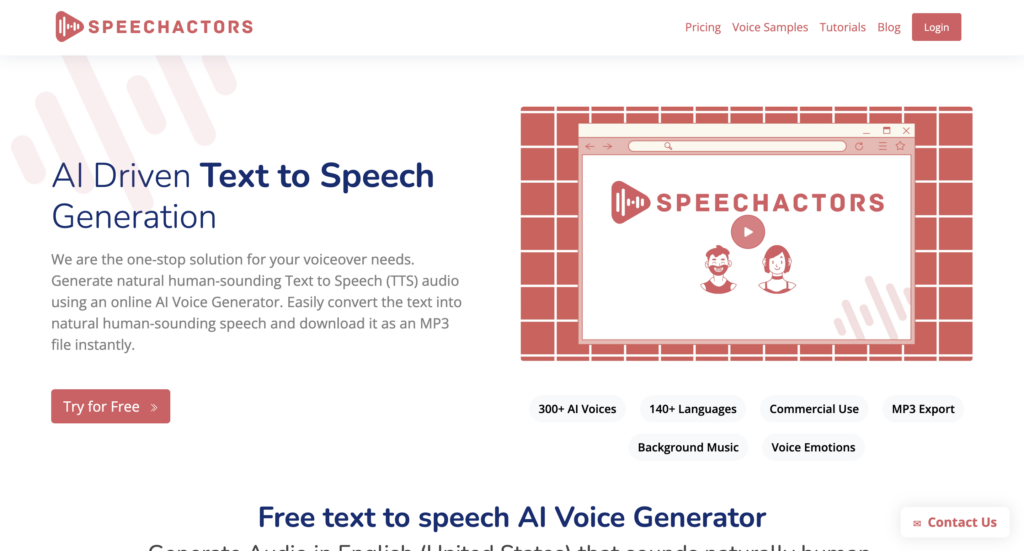
Speechactors stands out as a powerful tool for podcasters looking to monetize. It is a cloud-based AI text-to-speech platform that gives creators access to over 300 natural-sounding voices across 129 languages and accents. For a podcaster, this versatility is essential.
You can cast a female voice for a wellness ad and a deep male voice for a security product sponsorship, all from the same dashboard. Speechactors supports faster content creation by allowing users to upload scripts and instantly download studio-quality MP3s. The benefits for monetization are clear. First, the cost reduction is massive compared to hiring freelancers. Second, the scalable workflow means you can produce five ad reads in the time it takes to record one manually.
Third, the natural voice quality ensures that listeners remain engaged. The platform also allows for background music integration, meaning you can produce a fully finished, polished ad spot in one go. This capability creates a professional “agency-level” sound that commands higher ad rates. If you are ready to streamline your production and boost your revenue, exploring a tool like this is the next logical step.
People Also Ask (PAA)
How do AI voices help podcast creators make more money
AI voices help podcast creators make more money by reducing production cost, increasing ad volume, and enabling personalized, multilingual, and scalable content.
Is AI voice technology good for sponsorships
AI voice technology improves sponsorship performance by delivering consistent, high quality ad reads that match brand tone.
Can AI voices increase podcast ad revenue
AI voices increase podcast ad revenue by allowing dynamic ad insertion and targeted message variations.
Are AI-generated ads effective
AI-generated ads are effective because personalized audio increases listener engagement, according to marketing research.
Conclusion
AI voices are doing more than just mimicking human speech; they are expanding the financial horizons of the podcasting industry. By driving efficiency, enabling massive scale, allowing for deep personalization, and breaking down language barriers, synthetic voices are essential tools for modern monetization. They allow creators to treat their show as a scalable business rather than a time-intensive hobby.
The evidence is clear. From reduced production costs to increased ad inventory and global reach, the math supports the adoption of AI. As the technology continues to improve, the line between human and synthetic audio will blur further, making the content the star. For creators, the message is simple: adopting AI voice technology is the most effective way to future-proof your revenue and maximize the value of every minute of audio you produce.