

Your brand is more than just a logo or a color palette. It is the sum of every interaction a customer has with your business, and increasingly, that interaction is auditory. As companies shift toward video content, podcasts, and automated support, the “voice” of your brand has become a critical asset. However, integrating Artificial Intelligence (AI) into this mix introduces a new challenge: how do you ensure the robot doesn’t sound like a stranger?
Brand consistency in AI-generated audio means ensuring your digital voice remains recognizable, trustworthy, and aligned with your identity across every channel. Whether it is an explainer video or a customer support line, the tone must feel familiar. Speechactors offers a robust platform designed to solve this exact problem, providing scalable, customizable AI voice creation that keeps your brand sounding like you, every single time.
Why Brand Consistency Matters in AI Voice Production
When a customer interacts with your brand, they are subconsciously building a relationship based on trust. Consistency is the foundation of that trust. If your marketing videos use a high-energy, youthful voice, but your product tutorials use a slow, robotic, and deep voice, it creates cognitive dissonance. The customer may not explicitly notice the change, but the disjointed experience erodes the feeling of a unified, professional entity.
Audio identity plays a massive role in brand recall and differentiation. Think of the most famous tech companies; you can likely hear their “voice” in your head. It is clean, helpful, and articulate. Maintaining a unified brand voice allows you to own a specific sonic space in your niche. Marketing studies consistently show that cohesive branding across all channels visual and auditory increases revenue by significant margins. When the tone stays consistent, engagement rises because the audience knows exactly who is speaking to them before they even see the logo.
Core Elements of a Consistent Brand Voice
To maintain consistency, you must first dissect what your voice actually is. It is not enough to simply choose “Male” or “Female.” You must define the tone and personality. Is your brand authoritative and serious, like a financial institution? Or is it warm, empathetic, and conversational, like a lifestyle app? This personality must remain static, even if the actual words change.
Pace, clarity, and articulation are equally important. A luxury brand often speaks at a measured, deliberate pace to convey exclusivity. A discount retail brand might speak quickly to convey urgency. These technical aspects of speech define the listening experience. Furthermore, you must consider emotional resonance. Does the voice sound happy? Concerned? Neutral? Finally, your audio must align with your visual guidelines. If your website is minimalist and clean, a cluttered, fast-paced, or noisy voiceover will feel out of place.
Challenges When Using AI Voices
While AI text-to-speech (TTS) technology has advanced rapidly, it is not without pitfalls for branding. The primary challenge is variability. different AI models or even the same model with different settings—can produce vastly different outputs. Without strict controls, one video might sound perfect, while the next sounds metallic or disjointed.
Another major hurdle is inconsistent emotional delivery. A human actor intuitively knows to sound sad when reading bad news. An AI might read a tragic sentence with a cheerful lilt if not properly directed. This breaks immersion instantly. Additionally, scaling is difficult. As you expand into multilingual content for global markets, keeping the “spirit” of the voice intact is hard. A brand voice that sounds friendly in English might sound aggressive in German if you don’t use the right tools. Over-automation is the final risk; relying too heavily on default settings can strip away the authenticity that connects with humans.
How to Maintain Brand Consistency When Using AI Voices
5.1 Create a Brand Voice Profile
Before generating a single file, you need a blueprint. Create a Brand Voice Profile that functions like a buyer persona but for your audio. Document the specific attributes of your voice. Use descriptors like “Calm,” “Professional,” “30-40 years old,” or “Tech-savvy.” Define your target audience and the emotional output you want to trigger in them. Crucially, include examples of “Do’s and Don’ts.” For instance, “Do sound helpful; Don’t sound patronizing.”
5.2 Build Standardized AI Voice Guidelines
Once the profile is set, get technical. Build a standardization document for your team. This should include pronunciation instructions for your brand name and industry jargon (e.g., “Read ‘SaaS’ as ‘sass’, not ‘S-A-A-S'”). Establish rules for speed settings, pitch adjustments, and pause durations. This ensures that if a different team member generates audio next month, they follow the exact same recipe you used today.
5.3 Use a Unified AI Voice Toolset
The easiest way to break consistency is to use different software for different projects. One tool’s “American Male” sounds nothing like another’s. Stick to a single, powerful platform. Speechactors is ideal here because it acts as a centralized hub for all your audio needs. By consolidating your production into one environment, you eliminate the variance between different AI engines.
5.4 Train Voices with Custom Samples
For the ultimate in consistency, move beyond stock voices. High-end platforms allow you to train voices using custom samples. By uploading reference audio—perhaps from a founder or a previous voice actor—you can create a unique voice model. This ensures that whether you are making a 15-second ad or a 3-hour training module, the voice timbre remains identical.
5.5 Create Saved Voice Presets within Speechactors
Consistency fails when you have to manually dial in settings every time. In Speechactors, you can modify a voice—adjusting the pitch, the speaking rate, and the specific emotional tone—and then save those settings as a “Preset.” This is a game-changer. Instead of remembering that you used “Speed 1.1x and Pitch -2,” you simply load your “Brand Explainer Preset.” This guarantees uniform delivery across every project, regardless of who is editing.
5.6 Maintain a Centralized Audio Library
Do not let your audio files live in scattered folders on different laptops. Maintain a centralized repository of approved voiceovers. This library serves two purposes: it allows for easy quality comparison to ensure new files match old ones, and it acts as a reference point for external agencies or freelancers. If you hire a video editor, you can send them the library and say, “Make it sound like this.”
5.7 Conduct Regular Quality Checks
Automation does not mean “set it and forget it.” You must implement audio review cycles. Listen to your content regularly. Perform A/B testing to see if your audience responds better to a slightly faster or slower pace. Use audience feedback to refine your settings. If users complain that the tutorials are hard to follow, your consistency settings might need a tweak toward clarity over speed.
How Speechactors Supports Brand Consistency
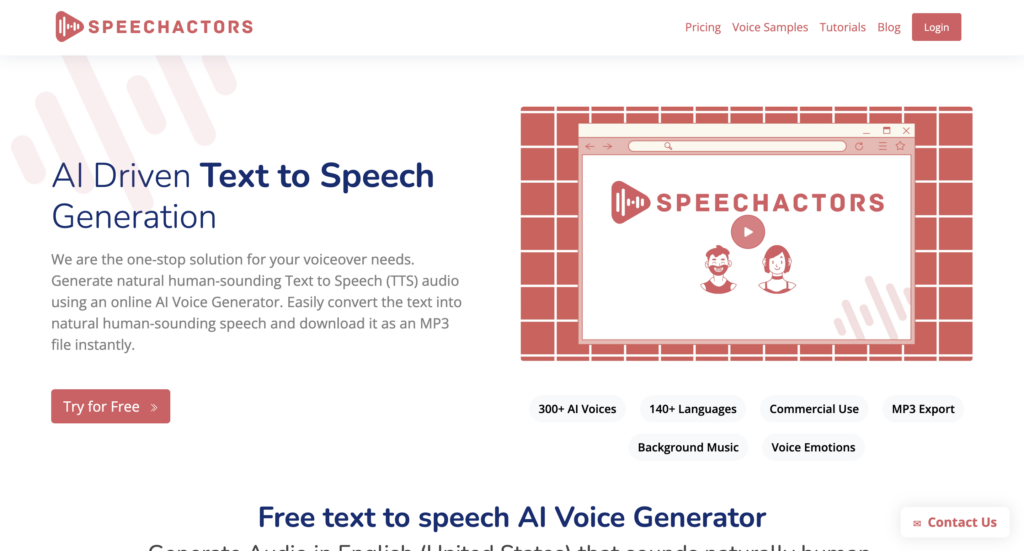
Speechactors is engineered specifically to address the fragmentation often found in AI audio. It provides custom voice creation capabilities that go far beyond standard TTS. You aren’t just typing text; you are directing a performance. The platform offers advanced emotion and tone controls, allowing you to fine-tune exactly how a sentence is delivered whether it needs to be whispered, shouted, or spoken with empathy.
The ability to store and reuse presets is critical for teams. You can define a “Project Voice” and share it, ensuring that the marketing team in New York and the support team in London generate audio that sounds like it came from the same person. Furthermore, Speechactors offers multi-language support that retains voice identity. You can have the same voice persona speak in Spanish, French, or Hindi, maintaining your brand character globally. Finally, for enterprise needs, API workflows allow for programmatic generation, ensuring scalable consistency even when automating thousands of files.
Best Practices for Scriptwriting for AI Voices
Even the best AI sounds bad if the script is poor. To help the AI maintain your brand voice, write for the ear, not the eye. Keep sentences concise. Long, winding sentences with multiple clauses can confuse the AI’s breathing and pacing logic. Short, punchy sentences yield the most predictable and natural delivery.
Add clear cues for the AI. Use punctuation strategically; commas add short pauses, while periods add longer ones. Use vocabulary that aligns with your brand persona. If your brand is high-end, use elevated language. If it is casual, use contractions. However, avoid idioms or ambiguous expressions. Phrases that have double meanings or unique cultural pronunciations can trip up the AI, leading to mispronunciations that break the listener’s immersion.
Real-World Examples of Brand Consistency with AI Voices
Consider the eLearning sector. A major educational platform replaced their rotating roster of freelance voice actors with a single, custom-tuned AI voice. The result was a seamless learning experience where Module 1 and Module 50 sounded exactly alike, increasing student retention rates because the “teacher” felt constant.
In the SaaS world, product tutorials often suffer from being updated at different times by different people. Companies using tools like Speechactors have synchronized their help centers. Now, when a feature is updated, they simply type the new script into their saved Preset. The new audio splices perfectly with the old audio, creating a unified library of support content. These examples prove that consistent audio leads to higher trust and a more professional user experience.
Conclusion
In the digital age, your brand’s voice is as important as its visual logo. Inconsistency in audio can confuse customers and dilute your professional image. However, by establishing clear profiles, standardizing your workflows, and utilizing advanced tools, you can harness the speed of AI without sacrificing the human connection.
Speechactors stands out as the premier solution for this challenge. With features like saved presets, emotional control, and custom voice cloning, it enables you to streamline production while keeping your brand identity rock solid. Don’t let your brand sound like a robot. Try Speechactors today to create scalable, professional, and consistent AI voiceovers that truly speak to your audience.