
If you are a content creator or business owner, you likely know the struggle of finding a good voiceover. You want something that sounds human, but hiring a professional voice actor is expensive and slow. This is where Text-to-Speech (TTS) tools come in. Naturally, the first instinct is to look for free options. Why pay when you can get it for free, right?
However, the reality is often different. Speechactors and free TTS tools serve very different needs. While free tools might save you money upfront, they often introduce hidden costs and technical limitations that affect quality, scalability, and legal safety. This article breaks down exactly why “free” isn’t always free in the long run and how professional platforms like Speechactors fill the gap.
Brief Context
The use of text-to-speech is exploding. It is no longer just for robotic phone menus. Today, TTS powers YouTube channels, podcasts, eLearning modules, audiobooks, and even Instagram Reels. Creators are building entire businesses around faceless channels and audio content.
In this rush to create content, many beginners make a critical decision mistake: choosing a free TTS tool without evaluating the long-term impact. They focus on the zero-dollar price tag today, ignoring the potential legal issues, engagement drops, and rebranding costs that hit them six months down the line.
What Are Free TTS Tools
Free TTS tools are essentially entry-level text-to-speech platforms. These are often designed as “demos” for paid services or as basic accessibility features built into browsers and operating systems. They offer a quick way to hear text read aloud but are rarely built for content production.
Key characteristics
- No cost entry: The most obvious benefit. You can type and listen immediately without a credit card.
- Limited voices and accents: You usually get a handful of standard “system” voices (like the default Google or Siri voices) which are recognizable and generic.
- Basic neural quality: While some free tools use neural networks, they often use older, less computationally expensive models that sound flatter.
- Usage caps: Most free tools have strict character limits (e.g., 500 characters at a time), making it impossible to convert long scripts.
- Watermarks or attribution requirements: Some tools require you to verbally credit them in your video or display a visual watermark.
Common examples
- Google Translate TTS: Often used by meme channels, but lacks professional cadence.
- Browser-based TTS tools: Simple websites that use your computer’s built-in accessibility voices.
- Open source TTS demos: GitHub projects that are powerful but require coding knowledge to run effectively.
What Is Speechactors?
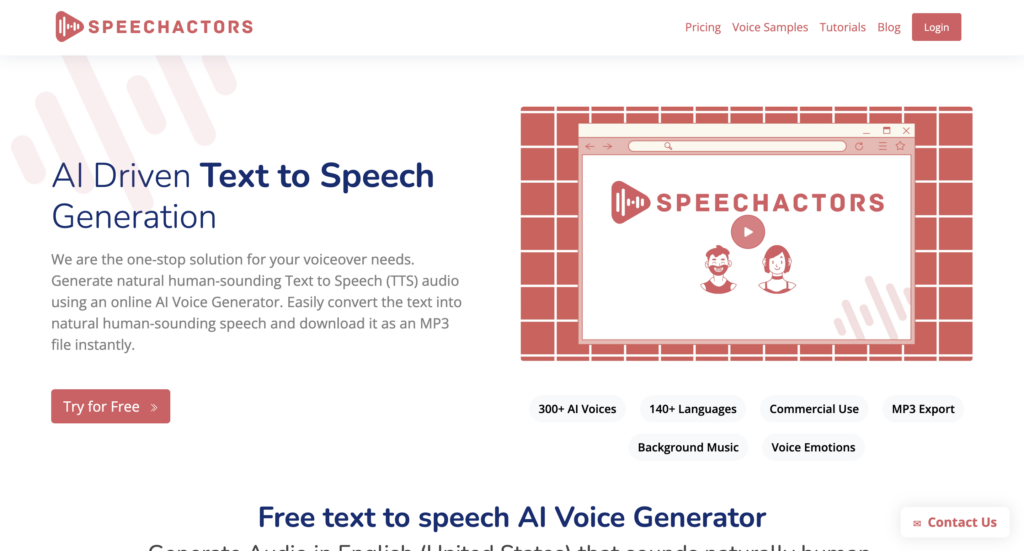
Speechactors is a professional AI voice platform designed specifically for content creators and businesses. Unlike free tools which are utilities, Speechactors is a creative suite. It focuses on generating studio-grade voices that are indistinguishable from human speakers, with a heavy emphasis on commercial safety and workflow.
Core attributes
- Human-like neural voices: The platform uses advanced deep learning to capture breath, pause, and intonation, making the speech sound natural rather than computed.
- Multiple languages and accents: It covers a vast array of global languages and specific regional accents, which is crucial for localizing content.
- Commercial usage rights: This is the biggest differentiator. A license with Speechactors grants you the legal right to monetize the audio on YouTube, Spotify, and other platforms.
- Consistent voice output: You can save specific voice settings to ensure your “brand voice” sounds exactly the same across 100 different videos.
- Scalable for creators: Features like merging audio files and background music integration are built-in to save editing time.
Primary use cases
- YouTube videos: Faceless “cash cow” channels that require high retention.
- Podcasts: Intro/outro segments or entirely AI-hosted shows.
- Audiobooks: Converting written books into audio formats for sale.
- Corporate training: Internal HR videos that need to sound professional, not robotic.
- Marketing voiceovers: Social media ads where tone and energy drive sales.
Direct Comparison Overview
When you line them up side-by-side, Speechactors and free TTS tools differ significantly in quality, control, legality, and scalability. It is comparable to the difference between using Microsoft Paint and Adobe Photoshop. Both can create images, but only one is built for professional work.
Comparison dimensions
- Voice realism: Free tools often sound “steppy” or disjointed. Speechactors maintains a fluid rhythm that mimics human conversation.
- Language and accent depth: Free tools might offer “English,” but Speechactors offers “English (US – Southern),” “English (UK – Formal),” and “English (Australian – Casual).”
- Customization: Free tools rarely let you change pitch or speed accurately. Speechactors allows for fine-tuning specific words.
- Licensing: Free tools are legally gray for business. Speechactors provides a clear license.
- Support and reliability: If a free tool goes offline or changes its code, you are stranded. Paid platforms offer stability.
Hidden Costs of Free TTS Tools
This is where the “free” aspect starts to fall apart. Free TTS tools appear cost-effective on day one, but they introduce indirect costs that accumulate over time. These aren’t costs you pay with a credit card; you pay them with time, reputation, and risk.
Time Cost
Using a free tool is rarely a “click and done” process. Because the output is often flat, you end up spending hours in your video editing software trying to fix it.
- Manual editing: You have to cut out awkward pauses or speed up slow sections manually.
- Frequent regeneration: You might have to generate the same sentence ten times hoping for a better result, whereas a pro tool gets it right the first time.
- Pronunciation errors: Free tools often stumble on complex words or brand names, forcing you to rewrite your script phonetically just to get the computer to say it right.
Research evidence:
Studies from institutions like the MIT Media Lab have explored human-AI interaction, consistently finding that low-quality synthetic speech reduces listener retention and trust. If your voiceover sounds fake, viewers click away faster. That drop in retention kills your algorithmic reach on platforms like YouTube, costing you potential ad revenue.
Branding Cost
Your brand voice is your identity. If you use a free TTS voice, you sound like everyone else.
- Inconsistent voice identity: Free tools often rotate or remove voices without warning. If your “brand voice” disappears, you have to re-record everything.
- Generic voices: Using the standard “TikTok voice” or “Google Translate voice” signals low effort to your audience. It makes your content feel cheap and disposable.
- No brand recall: A unique, professional voice helps people recognize your content instantly. A generic robot voice blends into the background noise.
Legal and Licensing Risk
This is the most dangerous hidden cost. Most free TTS tools are free for personal use only.
- No commercial license clarity: Their Terms of Service often forbid using the audio for commercial gain (ads, sponsorships, course sales).
- Risk of copyright claims: If the free tool uses a voice based on a real actor without proper clearance, you could be liable.
- Platform monetization issues: YouTube and Audible are cracking down on low-effort, mass-produced AI content. Having a verifiable license from a provider like Speechactors protects your channel standing.
University reference:
Reports from Stanford Human-Centered AI (HAI) highlight licensing ambiguity as a major risk in AI adoption. When you don’t know the data source or the rights associated with an AI output, you are building your business on a legal landmine.
Technical Limitations of Free TTS Tools
Beyond the legal and time costs, free tools simply cannot do what professional tools do technically. The engines driving them are optimized for speed and low cost, not quality.
Voice Quality Limitations
- Flat prosody: Prosody refers to the rhythm, stress, and intonation of speech. Free tools often read sentences with a flat, monotone delivery, failing to raise the pitch at the end of a question or pause for emphasis.
- Unnatural pauses: They often breathe in the wrong places, breaking the flow of a sentence and making it hard for the listener to follow the logic.
- Poor emotional variation: You cannot tell a free tool to sound “excited” or “sad.” It reads a funeral notice with the same tone as a birthday wish.
Language and Accent Restrictions
- Limited regional accents: If you are targeting a specific demographic—say, a Nigerian audience or an Indian audience—free tools usually offer a generic, slightly robotic “International English” that doesn’t resonate with locals.
- Poor pronunciation: They struggle heavily with non-English names, technical jargon, and acronyms, often reading them letter-by-letter instead of as a word.
Scalability Issues
- Daily character limits: If you have a 3,000-word blog post to convert, a free tool with a 500-character limit requires you to copy-paste 6 times and stitch the audio files together manually.
- No bulk processing: You cannot upload a CSV of 50 scripts and get 50 MP3s back. You have to do them one by one.
- No API reliability: If you are a developer trying to build an app, free APIs are slow, rate-limited, and prone to crashing.
Speechactors Advantages Over Free TTS Tools
Speechactors is built to solve the specific problems listed above. It is an investment in workflow efficiency and asset quality.
Professional Voice Quality
Speechactors utilizes “Emotion-aware” neural speech. This means you can often direct the AI. You can select a “News Anchor” style for authority or a “Friendly” style for marketing. The pacing is natural, and the tone varies based on the context of the sentence, keeping the listener engaged.
Commercial Safety
When you export a file from Speechactors, you own the rights to use it in your commercial projects. This clarity is essential for anyone building a business. You can safely run ads, sell courses, or monetize your YouTube channel without fear of a copyright strike from the voice provider.
Multilingual Strength
Speechactors supports global languages with high accuracy. It doesn’t just translate; it models the accent. An AI voice for French Canadian will sound distinct from European French. This allows you to repurpose your content for different countries effectively.
Creator and Business Focus
The platform is designed for power users.
- Batch processing: Handle large scripts in one go.
- Consistent output: The voice you choose today will be there next year.
- Platform stability: No crashes or queues when you are on a deadline.
When Free TTS Tools Are Acceptable
Despite the flaws, free tools have their place. If you are not making money from the content and quality isn’t critical, they work fine.
Valid scenarios
- Personal learning: If you just want to listen to a PDF while you cook dinner, a free tool is perfect.
- Prototype testing: If you are mocking up a video script to see if the timing works before hiring a real actor, a free TTS is a quick placeholder.
- Internal demos: Showing a rough idea to a colleague where polish doesn’t matter.
When Speechactors Is the Better Choice
However, as soon as the audio leaves your personal computer and enters the public domain, you need a professional tool.
Ideal scenarios
- Content monetization: If you plan to make even one dollar from the video, you need the license Speechactors provides.
- Professional media production: Podcasts and audiobooks require high-fidelity audio (WAV/MP3) without background hiss or robotic artifacts.
- Enterprise training: Employees learn better when the instructor sounds engaging.
- Marketing campaigns: Your ad spend is wasted if the voiceover annoys the potential customer.
Cost Comparison Summary
It is easy to think Speechactors is “expensive” and free tools are “cheap.” But you must look at the Total Cost of Ownership (TCO).
Cost factors compared
- Initial price: Free tools win ($0 vs Subscription).
- Time investment: Speechactors wins. (Converting a script takes minutes vs. hours of fixing/stitching with free tools).
- Output quality: Speechactors wins (Broadcast ready vs. Amateur).
- Revenue impact: Speechactors wins (Higher retention leads to higher ad revenue and sales).
If you value your time at even $10 an hour, spending 5 hours fixing free audio costs you $50. A subscription to a pro tool often costs less than that and saves you the headache.
People Also Ask
Is free text to speech safe for commercial use?
Generally, no. Free text-to-speech tools often lack clear commercial licenses. Using them for YouTube monetization, ads, or products can expose you to legal risks, copyright strikes, and demonetization because you do not own the rights to the voice generation.
Why does AI voice quality matter?
Voice quality is directly linked to audience retention. Higher quality, human-sounding AI voices improve engagement and trust. According to university-backed media studies, listeners fatigue quickly when listening to robotic, low-quality synthetic speech, causing them to stop listening sooner.
Can free TTS replace professional voice platforms?
No, free TTS cannot match professional platforms in voice realism, scalability, or licensing reliability. While they are useful for personal tasks, they lack the emotional range, accent accuracy, and legal protection required for professional broadcasting and business applications.
Final Words
Speechactors delivers significantly higher value than free TTS tools by removing hidden costs, improving voice realism, and ensuring commercial safety. While free tools are a tempting starting point, they are a trap for anyone serious about content creation.
The lack of commercial rights and the robotic quality will cap your growth. Investing in Speechactors is investing in the perceived quality of your brand.