
Creating engaging online courses is harder than ever. You have the content, but delivering it in a way that sticks is the real challenge. Text-heavy slides often bore learners, leading to drop-offs. That is where voice comes in. Adding audio transforms a static page into an active learning experience.
However, hiring human voice actors for every module is slow and expensive. Updates become a nightmare. This guide explores how AI voiceovers are solving these problems for Learning Management Systems (LMS). We will look at real use cases, integration tips, and why tools like Speechactors are changing the game for educators.
What Are AI Voiceovers in E-Learning
AI voiceovers are essentially synthetic speech created by advanced text-to-speech (TTS) technology. Unlike the robotic voices of the past, modern AI models use deep learning to mimic human intonation, pacing, and emotion. In the context of e-learning, this technology takes your written scripts whether for a slide deck, a video explanation, or a quiz and instantly converts them into high-quality audio files. This process removes the need for a recording studio, expensive microphones, or scheduling time with professional actors.
For course creators, this means you can turn a text-based lesson into an audio-visual experience in seconds. The technology analyzes the text to understand context, ensuring that a question sounds like a question and an important instruction carries the right weight. It is not just about reading words aloud; it is about creating a natural flow that helps students process information. By using AI voiceovers, educational platforms can produce consistent, clear, and professional-sounding audio that scales with their library of content, regardless of how many courses they produce or update daily.
Why Voice Matters in Online Learning
Voice is a critical component of effective learning because it directly impacts how our brains process information. According to cognitive load theory, people learn better when information is presented through two channels visual and auditory rather than just one. When a student has to read a dense block of text while looking at complex diagrams, their visual channel gets overloaded. Adding voice allows the learner to listen to the explanation while focusing their eyes on the visual aid, balancing the cognitive load and making it easier to understand difficult concepts.
Beyond just mechanics, voice adds a human element to digital environments. A warm, encouraging voice can motivate a learner who is struggling with a tough module. It sets the pace of learning, forcing the student to slow down and absorb the material rather than skimming through text. Voice also improves accessibility and retention. Research consistently shows that multi-sensory learning leads to better recall rates. By ignoring audio, course creators are leaving a massive opportunity for engagement on the table. Voice turns a passive reading assignment into an active, guided lesson that feels personal and direct.
Key E-Learning Use Cases for AI Voiceovers
AI voiceovers are incredibly versatile and fit into almost every corner of a modern digital education strategy. Their primary application is course narration for self-paced modules. Instead of forcing students to read long PDFs, creators can generate audio guides that walk them through the material slide by slide. This keeps the learner moving forward and reduces fatigue.
Another major use case is video lectures and microlearning. Creating short, focused videos is a trend in L&D (Learning and Development). AI allows you to produce these videos rapidly without waiting for a narrator to record the script. You simply upload the text, get the audio, and sync it with your animation or screen recording.
Quiz instructions and assessment prompts also benefit from audio. Hearing a question read aloud can help clarify the intent and reduce anxiety for test-takers. Furthermore, onboarding and compliance training often dry and repetitive becomes more digestible with a consistent voice guiding new hires through policies. Finally, scenario-based simulations use AI to provide different voices for different characters in a role-play, making the training realistic without hiring a cast of actors.
AI Voiceovers in LMS Platforms
Learning Management Systems (LMS) are the backbone of digital education, and integrating AI voiceovers into them streamlines the entire production workflow. Rather than creating audio externally and uploading huge files, many modern workflows allow for tighter integration. This creates a seamless experience where the audio feels native to the platform, enhancing the user interface and user experience (UX) for the learner.
Different LMS platforms utilize these assets in specific ways. For instance, Moodle is widely used in higher education. Here, AI voiceovers are perfect for narrating entire course modules or providing auditory feedback on quizzes, making the open-source platform feel more premium. TalentLMS, popular for corporate training, uses AI voice to churn out employee training modules quickly, ensuring that compliance updates are narrated instantly.
Canvas, a giant in the academic world, supports AI audio to make course delivery more accessible to students with different learning needs. Docebo, known for enterprise learning personalization, can use AI voices to tailor content delivery, perhaps using different tones or speeds depending on the learner’s preference. This integration reduces the technical burden on instructional designers and speeds up the “time-to-live” for new courses.
Benefits of AI Voiceovers for E-Learning Providers
The shift to AI voiceovers provides immediate, measurable benefits for e-learning providers. The most obvious advantage is faster course production cycles. What used to take weeks casting, booking studios, recording, editing now takes minutes. This agility is crucial for industries where information changes fast, like tech or healthcare.
Lower costs are another massive factor. You eliminate studio fees and actor hourly rates. This budget can then be reinvested into better instructional design or visuals. Consistency is also key; a human actor’s voice might change over time, or they might be unavailable for a retake a year later. AI voices never age, get sick, or quit. You can update a single sentence in a 10-hour course without re-recording the whole section, ensuring a consistent tone across all materials.
Furthermore, these tools support multiple languages and accents, allowing you to serve a global audience instantly. This flexibility leads to improved learner engagement and completion rates. When content is easy to listen to and available in a native language or preferred accent, students are less likely to drop out and more likely to finish the certification or degree.
Accessibility and Inclusive Learning Impact
Accessibility is not just a nice-to-have feature; it is a legal and ethical requirement for education. AI voiceovers are a powerful tool for aligning with WCAG (Web Content Accessibility Guidelines). For learners with visual impairments or blindness, high-quality audio is essential. Screen readers are great for navigation, but a dedicated, natural-sounding voiceover for course content provides a far superior learning experience than a robotic system voice.
Beyond visual impairments, AI voiceovers support students with dyslexia or literacy challenges. “Read-aloud” functionality allows these learners to listen to the text while reading it, a technique known to improve reading comprehension and fluency. It also helps neurodivergent learners who may find it hard to focus on large blocks of text.
By offering an auditory alternative, you make learning inclusive. You ensure that no student is left behind simply because the content format didn’t match their needs. AI makes providing this level of accessibility standard and affordable, rather than a specialized, expensive add-on.
Multilingual Learning at Scale
One of the biggest hurdles in e-learning is localization. If you are a global company or an educational institution with international students, you need content in multiple languages. Traditionally, this meant hiring native speakers for every single language a logistical and financial nightmare. AI voiceovers completely remove this barrier.
With AI, you can take a single English script and generate audio in Spanish, Mandarin, French, German, and Hindi within minutes. The best AI models even handle regional accents, such as Mexican Spanish versus European Spanish, or British English versus American English. This allows you to localize content rapidly.
It is not just about translation; it is about cultural relevance. Hearing a lesson in a familiar accent builds trust and improves retention. This capability allows e-learning providers to scale globally without exponentially increasing their headcount or budget. You can launch a course in 20 countries simultaneously, ensuring every learner gets the same high-quality educational experience.
AI Voiceovers vs Human Voiceovers for E-Learning
The debate between AI and human voiceovers is common, but the answer usually depends on the specific use case. AI voiceovers are the clear winner for content that needs to be scalable, frequently updated, or produced on a tight budget. If you have technical training manuals, compliance courses, or standard operating procedures that change every quarter, AI is the only practical choice. It allows for instant edits and maintains perfect consistency.
Human voiceovers, on the other hand, still hold an edge in high-stakes, brand-sensitive, or highly emotional storytelling. If you are creating a flagship leadership program or a deeply emotional case study, a human actor might convey the nuance and empathy better. However, the gap is closing fast. Modern AI can now whisper, show excitement, and pause for effect. For 90% of standard e-learning content lectures, instructions, explainer videos AI is now indistinguishable from a standard human narration and offers superior logistical benefits.
Why Speechactors Is Built for E-Learning Voiceovers
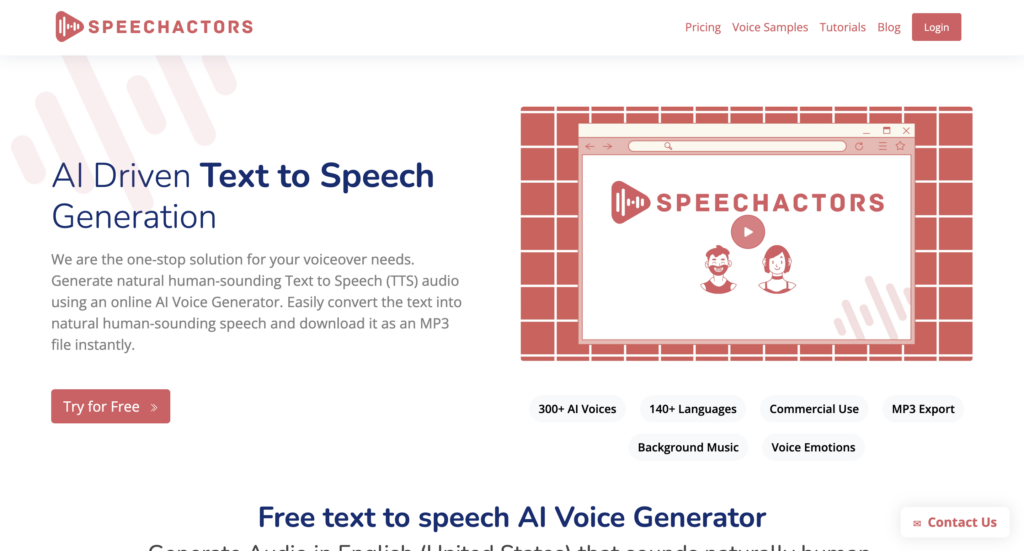
When choosing a tool for education, you need more than just a generic text-to-reader. Speechactors is specifically designed to meet the rigorous demands of e-learning. The platform focuses on clarity, neutrality, and pacing three things essential for instruction. An overly dramatic voice is distracting in a classroom setting; Speechactors provides voices that are calm, authoritative, and easy to listen to for long periods.
The platform offers natural-sounding educational voices that don’t fatigue the listener. It includes a vast library of multiple languages and accents, making it a one-stop shop for global course creators. Crucially, it supports SSML (Speech Synthesis Markup Language) tags. This allows instructional designers to control the break time between sentences, emphasize specific keywords, or slow down the speaking rate for complex topics granular control that is vital for teaching. With commercial usage rights included, you own the audio you generate, keeping you safe from copyright issues. The API capabilities also mean it can fit smoothly into existing LMS workflows, automating the audio generation process.
How to Implement AI Voiceovers in Your LMS
Implementing AI voiceovers is a straightforward process, but following a structured workflow ensures the best results.
- Prepare Structured Scripts: Do not just copy-paste your slide bullets. Write a script intended for the ear. Use shorter sentences and conversational language. Mark where you want pauses or emphasis.
- Generate with Speechactors: Input your text into the platform. Select a voice that matches your subject matter—perhaps a deep, serious voice for compliance and a bright, energetic voice for creative design. Use SSML tags to adjust pacing.
- Sync Audio: Download the audio files and import them into your authoring tool (like Articulate Storyline or Adobe Captivate) or directly into your LMS. Align the audio so it matches the appearance of text or animations on the screen.
- Test for Clarity: Listen to the full module. Does the voice speed match the reading speed? Is the pronunciation of technical jargon correct? Most AI tools allow you to tweak pronunciation easily.
- Deploy: Publish the course to your LMS. Since the files are digital, if you find a mistake later, you can just regenerate that one sentence and re-upload.
Future of AI Voiceovers in Digital Education
The future of AI in education is moving toward hyper-personalization. We are approaching a time when adaptive learning systems will change the voiceover in real-time based on the learner’s behavior. If a student is struggling and re-watching a section, the AI might switch to a slower, more explanatory tone. If a student is breezing through, the voice might speed up and become more concise.
We will also see real-time content updates. Imagine a news event happens that is relevant to a political science course. The professor could type a paragraph, and the AI would instantly narrate it into the live course module for students to hear that same day. Data-driven narration will become the norm, where the “teacher’s voice” adapts to the specific needs, language, and speed preferences of the individual student, creating a truly 1-on-1 tutoring experience at scale.
People Also Ask
What are AI voiceovers used for in e-learning?
AI voiceovers are used to narrate courses, explain lessons, guide assessments, and improve accessibility in digital learning environments. They turn text-heavy slides into audio-visual experiences.
Are AI voiceovers suitable for professional courses?
Yes, AI voiceovers are suitable for professional training when clarity, consistency, and scalability are required. Modern AI voices are natural and professional, making them perfect for corporate and technical training.
Can AI voiceovers replace human narrators in LMS content?
AI voiceovers replace human narration for repetitive, update-heavy, and multilingual learning content. While humans are still used for highly emotional storytelling, AI is the standard for scalable educational material.
Conclusion
AI voiceovers have graduated from a novelty to a necessity for modern e-learning. They offer a scalable, cost-effective solution to the age-old problem of producing high-quality audio content. By integrating tools like Speechactors into your LMS workflow, you can create accessible, engaging, and multilingual courses that reach learners everywhere.
Whether you are training a global workforce or teaching a university class, AI voice technology ensures your message is heard clearly, consistently, and effectively.