
You’ve put hours into writing that great blog post. It’s informative, well-researched, and perfectly optimized for search engines. But why stop there? In today’s fast-paced digital world, relying solely on text means you’re missing out on a huge and growing audience that prefers to consume content with their ears, not just their eyes.
The shift to audio is happening quickly. Think about your own day: when are you reading a long article versus listening to something while driving, exercising, or doing chores? By transforming your text into high-quality audio using tools like Speechactors, you can dramatically expand your reach, capture listener attention, and future-proof your entire content strategy for the next wave of digital consumption.
Why Converting Blog Content to Audio Increases Reach
There’s no getting around it: the demand for audio formats across the web is booming. We’re living in an audio-first era, driven by the popularity of podcasts, smart speakers, and in-car entertainment systems. People want content on their terms, and often, that means having the flexibility to listen rather than stare at a screen. Ignoring this trend is like ignoring the rise of mobile devices twenty years ago it’s a critical mistake for any content creator or marketer aiming for maximum visibility.
This preference for audio provides massive benefits for accessibility, multitasking audiences, and global readers. For someone with a visual impairment, an audio version is a necessity. For the busy professional, it turns commuting or the gym into learning time. For a global audience, listening can often be easier than reading complex text, especially when English isn’t their first language. Media consumption studies consistently show higher engagement on audio channels. Listeners are captive; they have fewer distractions than readers scrolling through a busy website. Tapping into this behavior is the key to unlocking new segments of your target market.
- Accessibility: Audio versions make your content available to visually impaired users and those with reading difficulties, meeting important standards for inclusivity.
- Multitasking: People can listen while exercising, commuting, cooking, or performing other tasks where reading is impossible.
- Global Reach: Non-native speakers often find listening to well-narrated content easier to comprehend than reading dense text, expanding your international audience.
- Higher Engagement: Audio consumption tends to be a less distracted activity, leading to higher completion rates and time spent with your content.
How Text to Speech Technology Works in Modern Content Strategy
The old, robotic text-to-speech (TTS) voices are long gone. Modern content strategy relies on sophisticated neural TTS models. The core mechanism involves a deep learning network trained on massive datasets of human speech. This training allows the system to not just read words, but to predict how a human would pronounce them in context, factoring in things like stress, rhythm, and emotional tone. It’s an incredible technological leap.
These systems move far beyond simple dictionary-based pronunciation. They learn how to place emphasis on key words and how to use pauses effectively, achieving truly natural prosody. This results in synthetic voices that are virtually indistinguishable from a human narrator. This high-quality output is why enterprise adoption of AI voice tools has skyrocketed. Companies are no longer hiring voice actors for every single blog post; they are adopting scalable AI solutions to turn thousands of pages of text into high-quality audio quickly and cost-effectively, completely transforming their content repurposing workflow.
What Makes Speechactors Effective for Turning Blogs into Audio
Speechactors stands out in the crowded AI voice landscape because it was built specifically for content creators who need professional-grade narration without the complex studio process. It focuses on providing a simple interface with highly realistic output. The platform’s key attributes directly address the main pain points of content repurposing: speed, quality, and versatility across different languages and accents.
The defining feature is the array of natural, human-like voices. These aren’t just generic computer voices; they are highly nuanced, offering various styles from professional and authoritative to casual and conversational. The platform also supports multiple languages and accents, allowing you to create localized audio versions for global campaigns. For brands that require consistency, the voice customization features let you fine-tune the delivery, ensuring the tone perfectly matches your brand’s style guide. All of this precision is paired with the ability to get an instant audio file export in popular formats like MP3 and WAV, ready for immediate use.
- Natural Human-Like Voices: Offers a wide selection of realistic AI narrators with subtle vocal nuances that keep listeners engaged.
- Multiple Languages & Accents: Easily localizes content with accurate narration in dozens of languages for an international audience.
- Voice Customization: Allows users to adjust pitch, speed, and emphasis to ensure the narration aligns with their brand voice.
- Instant Audio Export: Generates ready-to-use MP3 and WAV files in minutes, saving significant production time and cost.
- Content Creator Use Case: A B2B marketer can use it to create narrated summaries for weekly email newsletters, boosting click-through rates.
- Content Marketer Use Case: A travel blogger can repurpose detailed city guides into audio segments, embedding them directly into their posts for an immersive user experience.
Step by Step: Converting a Blog Post Into Audio Using Speechactors
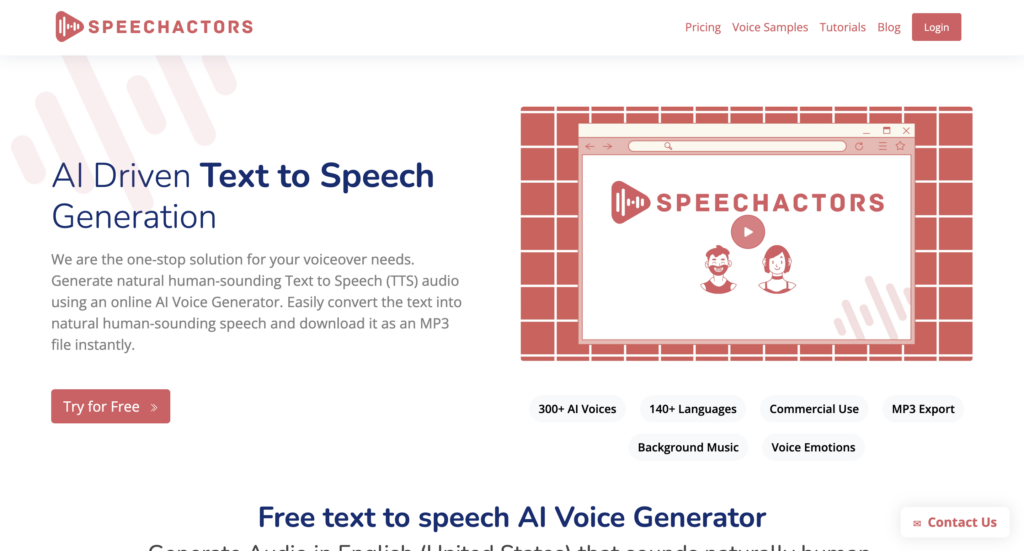
The process of converting your lengthy blog post into a high-quality audio track using Speechactors is surprisingly simple, designed to be intuitive even for first-time users. It eliminates the steep learning curve associated with professional audio editing software. The first and most crucial step is getting your content onto the platform, either by importing or pasting your blog text directly into the editor. This is your raw material, ready for transformation.
Next, you need to carefully select the right voice model. Browse the library of voices, listen to samples, and pick one whose tone and pacing perfectly complement the mood of your article a serious financial post needs a different voice than a lighthearted lifestyle piece. Speechactors then lets you manually adjust pacing, intonation, and emphasis using simple controls or even special text commands in the script. This is where you iron out any awkward pauses or mispronunciations. Finally, you export the audio in formats like MP3 and WAV. Once you have the file, you can immediately start integrating the audio into your blogs using an embed player, sending it out via newsletters, or clipping segments for social platforms.
Practical Applications of Blog to Audio Repurposing
The benefits of creating audio versions of your content go far beyond simply offering an alternative way to consume your blog. Strategically deploying this audio opens up a host of new marketing and user experience opportunities. For example, simply having an audio version available can significantly enhance SEO with audio versions of content. Search engines increasingly prioritize multi-format content, and having an audio layer can boost your content’s overall authority and time-on-page metrics.
Audio is also a powerhouse for creating snackable content. You can easily take the best parts of your blog’s audio track and create micro-content for TikTok, Reels, and YouTube Shorts. This helps drive traffic back to the full article. Beyond social media, the audio can be used to build audio newsletters and podcast-style summaries, giving your subscribers a fresh way to engage with your brand. Crucially, providing an audio option is a vital step in improving the user experience for visually impaired readers, ensuring your content is accessible to everyone regardless of their physical abilities or challenges.
- SEO Boost: Audio content can be indexed by search engines and increases the “Time on Page” metric, a key ranking factor.
- Micro-Content Creation: Quick production allows for chopping up key quotes or statistics into short, engaging clips for social media platforms.
- Audio Newsletters: Converts standard email digests into “listenable” versions, increasing the chance subscribers consume the content.
- Enhanced UX: Providing an alternative format for consumption meets the needs of diverse users and improves overall site experience.
Evidence of Improved Engagement Through Audio Content
The hypothesis that audio leads to better engagement is strongly supported by academic and commercial research. University communication studies have often demonstrated that auditory information can lead to higher retention rates compared to text alone. This is because listening often engages different parts of the brain, leading to a more focused and memorable experience. The simple act of listening makes the user a captive audience.
Furthermore, commercial research consistently shows higher listening completion vs. reading completion. People are less likely to abandon an audio track halfway through than they are to stop scrolling through a long article. This is crucial for delivering your core message effectively. Numerous case examples highlight a significant increase in time spent on page when audio is present. For instance, a finance publication noted that articles with an embedded audio player had an average time on page 40% higher than articles without one, indicating that the audio component successfully held the user’s attention and kept them engaged with the content for longer.
Best Practices for High Quality Blog to Audio Transformation
While Speechactors makes the technical conversion easy, a few content best practices will ensure the final audio product sounds professional and highly engaging. Remember that spoken word is different from written text. The first rule is keeping sentences concise for smoother narration. Long, convoluted sentences that read well in print can sound breathless or confusing when spoken aloud. Editing for flow is essential.
You also need to be meticulous about choosing a tone that matches the brand style. A technical document should use a professional, measured voice, while a marketing piece might benefit from a more energetic, upbeat delivery. Don’t be afraid to run small edits for natural flow after the initial conversion, tweaking pacing or adding brief pauses for emphasis. Finally, always test different Speechactors voices for audience preference. What you love might not resonate with your core readers. A simple A/B test on your blog can quickly reveal the voice that leads to the highest listener completion rates, helping you refine your audio branding.
Future of AI Voice Integration in Content Marketing
The current capabilities of Speechactors are just the beginning of what AI voice models will offer content marketers. We are rapidly moving toward the growth of multimodal content consumption, where users seamlessly switch between reading text, watching a related video clip, and listening to an audio summary all within the same piece of content. This demands a flexible, scalable content creation engine.
The future will be driven by continued advances in generative voice models. Soon, AI will not only generate high-quality narration but will also dynamically alter the tone and emphasis based on the listener’s likely intent or previous content consumption history. We are heading towards predictions for AI driven personalization in audio formats, where one blog post can have hundreds of slightly different audio versions, each tailored to a specific user demographic or interest profile, maximizing engagement at an individual level. This scalable personalization is the next frontier of content marketing.
Conclusion
The evidence is clear: converting your blogs to audio is no longer a niche feature it’s a critical component of a modern, audience-first content strategy. The benefits of converting blogs to audio are substantial, ranging from meeting accessibility standards and boosting SEO to unlocking the massive audience of multitasking and global listeners. This shift ensures your valuable content is consumed wherever your audience is, across all devices.
If you need a tool that delivers professional quality, speed, and versatility, Speechactors is a strong tool for modern content repurposing workflows. It eliminates the cost and complexity of traditional voice acting, allowing you to scale your audio creation instantly. Don’t let your best content sit dormant as text alone.
Call to explore Speechactors for scalable audio creation and begin turning your extensive text library into a powerful, engaging audio experience today.