
Brand consistency is the practice of delivering a uniform message, tone, and feel across every channel where your business appears. In the visual world, this means using the same logo, color palette, and fonts whether a customer is looking at your website, an Instagram ad, or a physical billboard. In digital communication, it extends to your “voice” not just what you say, but how you sound. It is the audio fingerprint that makes your brand instantly recognizable to your audience.
We are seeing a massive shift in how marketing teams produce content. The adoption of AI voice generation is rising fast because it solves the old problems of time and cost. You no longer need to book a recording studio or hire expensive voice actors for every single reel or tutorial. However, this speed brings a new risk: sounding like a different person in every video. This is where Speechactors comes in. It is a tool designed not just to generate speech, but to scale your voice production while keeping your brand’s audio identity locked in and secure.
Why Brand Consistency Matters in Voice Content
Your audio identity is directly linked to how much your audience trusts you. Think about a friend you talk to every day. If they suddenly started speaking with a different accent or a completely different pitch, you would feel confused or even suspicious. Brands work the same way. When a customer hears a familiar tone in your ads, your support videos, and your podcast intro, it builds a sense of reliability. They know who is talking to them.
Research consistently shows that cohesive brand experiences lead to better results. When a brand presents itself consistently, it can increase revenue by up to 23%. This is because consistency aids memory. If your audio identity is scattered serious in one video, overly cheerful in the next, and robotic in a third customers struggle to recall who you are. This hurts your conversion rates because trust is the foundation of every sale.
Consider the multi-channel world we live in. Your brand voice needs to live in 15-second TikTok ads, 10-minute YouTube explainers, and even internal training modules for your staff. If these sound like they come from three different companies, you break the immersion. A single, consistent voice acts as a thread that ties all these varied pieces of content together into one strong narrative.
Core Elements of a Consistent Brand Voice
Before you type a single word into an AI generator, you need to define what your brand actually sounds like. If you skip this step, you are just guessing. The first attribute to define is tone. Is your brand friendly and casual, like a helpful neighbor? Or is it authoritative and formal, like a financial advisor? This decision dictates the baseline for every audio file you generate.
Next, you must look at style parameters. This includes pacing, clarity, and articulation. A high-energy sports brand might speak quickly and punchy. A meditation app needs a slow, soothing, and deliberate pace. These aren’t just artistic choices; they are technical settings that need to be standardized.
Emotional cues are the third pillar. Your voice needs to carry the right emotion for the context. A “sorry we missed you” voicemail needs to sound empathetic, not cheerful. A product launch video needs excitement. Finally, you need strict rules for pronunciation. If your AI voice mispronounces your product name or industry technical terms, it instantly kills your credibility. You must define exactly how specific words are spoken to ensure you sound professional.
Challenges When Introducing AI Voices
Moving to AI voices isn’t without its bumps in the road. The biggest challenge is variation. Different AI models or even the same model with different settings can produce wildly different outputs. You might find a voice you love, but if you can’t replicate that exact sound next month, your consistency is gone.
Another common issue is emotional misalignment. AI is smart, but it doesn’t always “get” the context of a script unless you tell it. If you feed it a sad script but the settings are on “neutral,” the result will sound cold and robotic. This disconnect can alienate listeners who expect a human connection.
Pronunciation inconsistencies are also a frequent headache. Brand names, acronyms, and niche jargon are often tripped over by standard AI models. If one video says “SaaS” as “sass” and another spells it out as “S-A-A-S,” your audience will notice the lack of attention to detail.
Finally, there is the scaling issue. When you have a marketing team of five people all generating audio, they might all pick slightly different settings. Without a central system, you end up with a library of audio files that sound like a messy crowd rather than a unified brand.
How to Maintain Brand Consistency with Speechactors
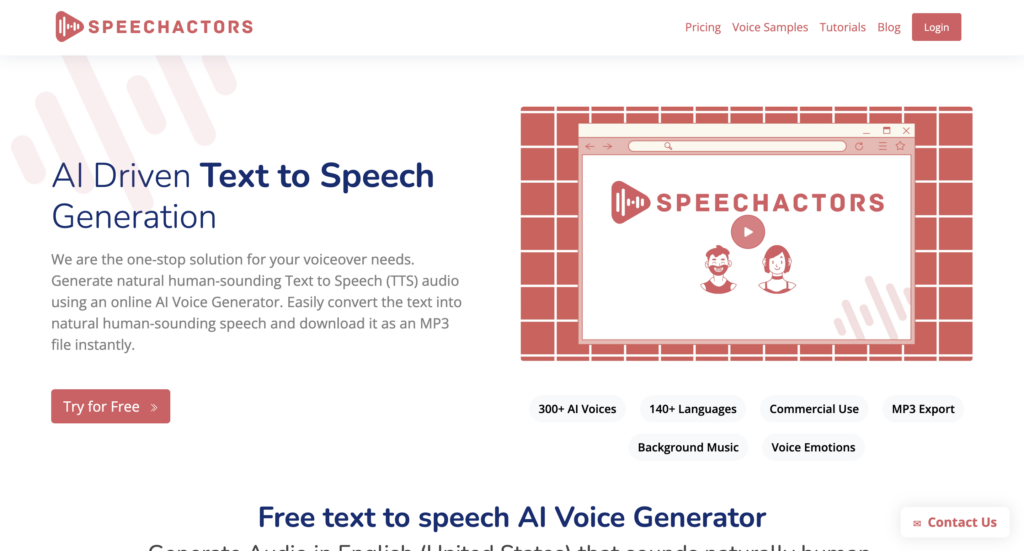
Speechactors is built to solve these specific consistency problems through a structured approach. The most powerful feature is the ability to use custom voice profiles. Once you dial in the perfect voice the right pitch, the right accent, the right gender you can save it. This profile becomes your “source of truth.” You don’t have to remember the settings; you just load the profile.
You should also use the platform to store reference scripts. These are “golden samples” of your audio that show your team exactly what good output sounds like. It acts as a benchmark. If a new file doesn’t match the reference, it doesn’t get published.
To get granular, Speechactors allows you to apply consistent SSML (Speech Synthesis Markup Language) settings. This sounds technical, but it just means you can control the fine details: exact pause lengths in milliseconds, specific emphasis on keywords, and rigid speed controls.
Voice cloning is another game-changer. If you have a spokesperson or a CEO whose voice is your brand, you can clone it. This allows you to create uniform content across every format without dragging that person into a recording booth every week.
Finally, team folders are essential for enforcement. By having a shared workspace in Speechactors, your entire team works from the same set of approved voices and projects. No one is going rogue with their own settings because the standard is right there in the shared folder.
Create a Brand Voice Guideline for AI Audio
To make this work, you need a document that serves as your bible. This is your Brand Voice Guideline. Start by documenting the specific settings you use. Don’t just say “use a happy voice.” Write down: “Use Voice ID: Sarah, Speed: 1.0, Pitch: Medium, Style: Cheerful.” This leaves no room for error.
Next, add a section for vocabulary. List your “brand-safe” words and phrases. equally important, list the “restricted” phrases you never want to hear. This is also where you put the phonetic spelling of your brand name and products so everyone knows how to fix pronunciation errors in the AI tool.
You should also create sample scripts for onboarding. When a new freelancer or employee joins, hand them a script and the audio file that matches it. Tell them, “Make it sound like this.” This creates a clear target.
Centralize these guidelines. Don’t leave them in a buried email. Put them in your Speechactors project description or a pinned document in your team folder. If the guidelines are easy to find, they will be used.
Quality Control and Review Framework
Even with the best tools, you need a human in the loop. Establish an audit method. You don’t need to listen to every second of every file, but you should spot-check assets before they go live. Listen specifically for tone drift does the voice sound tired or bored? That happens if the wrong settings are used.
Set clear criteria for evaluation. Ask three questions: Is the audio clear? Is the emotion right for the text? Does it sound like “us”? If the answer to any of these is no, it goes back for a revision.
Use version control. When you update an audio file in Speechactors, keep track of it. Don’t just overwrite files haphazardly. This helps you standardize updates so you don’t accidentally revert to an older, worse version of your voice.
Create feedback loops. Your marketing team writes the script, but the product team knows the product best. Make sure these teams talk. If the creative team thinks a voice sounds cool but the product team thinks it sounds unprofessional, you need to resolve that clash to protect the brand.
Best Practices for Scaling AI Voice Production
As you grow, you need to work smarter. Create master templates for your recurring content. If you make a weekly news update, the intro and outro music, the voice settings, and the pacing should be a template. You should only be changing the text in the middle.
Standardize your metadata. Name your files logically. “Ad_Campaign_Q1_V1” is better than “audio_final_final_2.mp3”. Good naming conventions make it easy to retrieve old assets and match their consistency later.
Automate settings where possible. In Speechactors, if you can set a default voice for a project, do it. This reduces human error. The less your team has to manually click and adjust, the more consistent your output will be.
Use collaboration dashboards. These give you a bird’s-eye view of what voice assets are being created. If you see a sudden spike in audio generation from one department, you can check in to ensure they are sticking to the guidelines.
Real Use Cases Where Consistency Shapes Brand Perception
Let’s look at e-learning companies. They often have hundreds of hours of training content. If the trainer’s voice changes every five minutes, the student loses focus. Successful companies use one consistent AI persona for the entire course, creating a relationship between the learner and the “instructor.”
SaaS platforms are another great example. They use identical narration across their onboarding videos. Whether a user is learning how to sign up or how to use a complex feature, the helpful, calm voice guides them through it, reducing anxiety and frustration.
Marketing teams dealing with global markets use AI to maintain tone across languages. A luxury brand can use Speechactors to generate an ad in English, Spanish, and French. By using similar voice profiles for each language, the “vibe” of the brand remains premium and exclusive, regardless of the language spoken.
Podcasters are also using this for continuity. They might use AI voices to read listener emails or sponsor segments. By using the same AI voice for these segments every episode, it becomes a familiar, expected part of the show format.
How Speechactors Supports Cross-Channel Brand Consistency
Speechactors is designed to be the hub for all these activities. Its voice cloning feature allows you to digitize your brand’s unique sound and deploy it anywhere. You aren’t limited to stock voices; you can own your sound.
The SSML control is what separates professional audio from amateur attempts. You can tell the voice exactly when to breathe and how hard to hit a consonant. This level of detail ensures that your audio doesn’t just sound good; it sounds intentional.
Multilingual support means your brand consistency doesn’t stop at the border. You can project the same brand personality to customers in Tokyo, Berlin, and New York simultaneously.
Most importantly, the project collaboration tools prevent silos. When your social media team, your support team, and your ads team are all working inside Speechactors, they are all pulling from the same library of approved voices. Automation takes the guesswork out of the equation, ensuring that your brand identity remains unified across ads, reels, IVR phone menus, tutorials, and huge campaigns.
Conclusion
Maintaining your audio identity while using AI voices is not just a technical task; it is a strategic necessity. Your voice is as important as your logo. If you let it fragment, you dilute your brand.
By using a dedicated platform like Speechactors, you gain the control you need. You can scale your production up to thousands of minutes of audio without ever losing that unique “sound” that makes your brand yours.
Don’t leave your brand voice to chance. Start creating your guidelines today, build your templates, and set up your review systems. Protect your brand integrity, and your audience will reward you with their trust and their business.