
An AI voice engine is a system that converts text into humanlike speech using machine learning, neural networks, and speech science. It is the core technology that allows computers to read words aloud with tone, emotion, and proper pacing, just like a real person.
This article explains the complete technical stack behind modern AI voice engines with direct relevance to Speechactors. We will break down the complex layers that turn written words into audio. Research from Stanford University and MIT confirms that neural speech synthesis significantly improves intelligibility and emotional realism compared to older technologies.
What Is an AI Voice Engine?
An AI voice engine is a software architecture that generates speech from text using trained neural models. It is not just a database of recorded sounds. Instead, it is a generative system that learns how to speak by analyzing thousands of hours of human audio. It integrates linguistics, acoustics, and deep learning to create new speech that was never explicitly recorded. This capability allows platforms like Speechactors to offer voices that sound fluid and alive rather than choppy or robotic.
The engine works by predicting sound waves based on input text. When you type a sentence, the engine does not look up pre-recorded words. It calculates the probability of how those words should sound in that specific context. This approach allows for infinite flexibility. You can change the speed, pitch, and emotion without needing a human actor to re-record the line.
Key Functional Objectives
- Natural pronunciation: The engine must correctly say complex words, names, and acronyms without stumbling.
- Emotional expressiveness: The voice should be able to sound happy, sad, angry, or professional based on the context.
- Real-time synthesis: The audio must be generated almost instantly so it can be used in apps and live interactions.
- Multilingual scalability: The system should easily learn new languages without rebuilding the entire core from scratch.
Studies from Carnegie Mellon University show neural text-to-speech systems reduce robotic artifacts by over 60 percent compared to rule-based systems. This reduction in errors is why modern AI voices are now used for audiobooks, marketing videos, and customer service agents.
Core Architecture of an AI Voice Engine
Text Processing Layer
This layer prepares raw text for speech synthesis. Before a computer can speak, it must understand the structure of the text. This process is called text normalization. The engine scans your input to fix formatting issues and expand abbreviations. For example, it converts “Dr.” to “Doctor” or “Drive” depending on the context of the sentence.
Components
- Text normalization: Cleans up the text and expands numbers, dates, and symbols into written words.
- Tokenization: Breaks sentences down into smaller units called tokens, which are easier for the AI to process.
- Phoneme conversion: Translates written letters into phonemes, which are the basic sound units of speech.
- Prosody prediction: Estimates the rhythm, stress, and intonation required for the sentence to sound natural.
If punctuation and syntax are correctly parsed, speech clarity increases significantly. The text processing layer acts as the director of the speech, telling the voice how to say the line before it actually makes a sound.
Linguistic and Phonetic Modeling
Phonetic modeling maps language rules to sound units. This step is critical because the same letter can sound different in different words. The engine uses a complex set of rules and learned patterns to decide the correct pronunciation. For instance, the “a” in “apple” sounds different from the “a” in “father.” The model identifies these subtle differences instantly.
Key Models Used
- Grapheme to phoneme models: These deep learning models predict the pronunciation of words based on their spelling.
- Stress and intonation predictors: These components determine which parts of a word should be emphasized to convey the right meaning.
University of Edinburgh research shows phoneme-level modeling improves pronunciation accuracy in multilingual engines. This accuracy is vital for global platforms like Speechactors, which support over 140 languages. By understanding the phonetic roots of each language, the engine avoids the “foreign accent” effect that plagued older text-to-speech tools.
Acoustic Model
The acoustic model converts phonemes into spectrograms. A spectrogram is a visual representation of audio frequencies over time. You can think of it as the “sheet music” for the voice. The acoustic model takes the phonetic information from the previous step and generates this detailed map of sound. It decides exactly how high or low the pitch should be at every millisecond.
Technologies Involved
- Deep neural networks: These networks process vast amounts of speech data to learn the connection between text and sound.
- Transformer based architectures: These advanced models pay attention to the entire sentence at once, ensuring the tone stays consistent from start to finish.
- Sequence to sequence learning: This technique maps the input text sequence directly to the output acoustic sequence.
Google Brain studies confirm transformer-based acoustic models outperform traditional RNNs in speech naturalness. This shift to transformers is a major reason why current AI voices can handle long pauses and breath sounds naturally, making the audio feel less like a machine and more like a human conversation.
Neural Vocoder
The vocoder transforms spectrograms into audible speech. This is the final step in the production line. The acoustic model creates the plan (the spectrogram), but the vocoder builds the actual sound wave. In the past, this was done using mathematical formulas that sounded buzzy and metallic. Today, neural vocoders use AI to generate the waveform sample by sample.
Common Vocoder Types
- WaveNet: One of the first neural vocoders, known for high quality but slower processing speeds.
- WaveRNN: A faster version that uses recurrent neural networks to generate audio more efficiently.
- HiFi GAN: A modern adversarial network that produces high-fidelity audio very quickly.
GAN-based vocoders reduce synthesis latency while maintaining studio-grade quality. They work by having two neural networks compete against each other—one tries to create fake audio, and the other tries to spot the fake. This competition forces the generator to create incredibly realistic sound waves that are indistinguishable from human recordings.
Voice Training Pipeline
Data Collection
High-quality voice engines rely on clean, diverse voice datasets. You cannot build a great AI voice from low-quality audio. The training data must be recorded in a professional studio with professional voice actors. The engine needs to hear the speaker in a quiet room with no background noise or echo.
Data Requirements
- Studio recorded speech: Audio must be crisp, clear, and free of any distortion or interference.
- Multiple emotions: The actor must read scripts in various tones—happy, sad, neutral, excited—so the AI learns emotional range.
- Accent variations: To support global users, data must include speakers from different regions and backgrounds.
Research from Oxford University highlights that dataset diversity directly affects voice realism. If the training data is too uniform, the resulting voice will sound flat and boring. Speechactors uses diverse datasets to ensure their library of 300+ voices covers a wide spectrum of human expression.
Model Training and Optimization
Training aligns speech patterns with linguistic intent. Once the data is collected, the heavy lifting begins. The AI model is “trained” by feeding it the text and the corresponding audio. It guesses how the text should sound, compares it to the real recording, and adjusts its internal connections to get closer to the truth. This process happens millions of times.
Optimization Methods
- Transfer learning: This allows the engine to take knowledge from one voice (like English) and apply it to another (like Spanish) to speed up learning.
- Fine tuning: The model is polished on a specific speaker’s data to capture their unique vocal quirks and style.
- Loss function calibration: This technical step measures how far the AI’s output is from the target audio and guides the correction process.
If training data is balanced, voice stability improves across use cases. This stability means the voice won’t suddenly crack or change pitch unexpectedly in the middle of a sentence, which is crucial for professional content creation.
Emotional and Expressive Speech Generation
How AI Adds Emotion
Emotion is controlled through prosody parameters. A human voice is never perfectly flat. We change our pitch, speed, and volume to show how we feel. An AI voice engine mimics this by adjusting these specific parameters dynamically. It does not just “add” emotion; it modulates the physical properties of the sound wave to simulate feelings.
Key Controls
- Pitch: Raising the pitch can indicate excitement or a question, while lowering it can signal seriousness or sadness.
- Speed: Speaking faster conveys urgency or energy, while speaking slower creates a calm or dramatic effect.
- Energy: Increasing the volume and intensity makes the voice sound confident or angry; decreasing it makes it sound soft or intimate.
MIT Media Lab research confirms emotional modeling increases listener engagement and trust. When a voice sounds genuinely empathetic, listeners pay more attention. This is why Speechactors provides tools to adjust these emotion settings manually, giving creators full control over the final performance.
Multilingual and Accent Support
Language Expansion Architecture
Modern AI voice engines support multiple languages through shared phonetic spaces. Instead of building a separate engine for every single language, advanced systems use a universal phonetic model. They map sounds from different languages into a shared space. This means the AI understands that the “p” sound in French is similar to the “p” sound in English, allowing it to learn new languages much faster.
Technical Advantages
- Reduced retraining cost: Adding a new language does not require recording thousands of hours of new audio from scratch.
- Faster language onboarding: New languages and accents can be deployed in weeks rather than years.
This architecture allows Speechactors to scale voices globally. It is how the platform can offer consistent quality whether you are generating audio in Japanese, German, or Hindi. The underlying engine uses its deep understanding of human speech physics to adapt to the unique rules of each language.
Real Time Inference and API Delivery
Low Latency Speech Generation
Inference engines optimize speed and reliability. “Inference” is the moment the AI actually generates the audio after you click “play.” For applications like voice bots or live translation, this needs to happen in milliseconds. Modern engines are highly optimized to run on powerful hardware that can do the math instantly.
Infrastructure Elements
- GPU acceleration: Graphics processing units are used to handle the massive parallel calculations needed for neural synthesis.
- Model compression: The AI models are shrunk down without losing quality so they load faster and use less memory.
- Edge deployment: Some engines can run directly on a user’s device, removing the need to send data to a cloud server.
If latency is reduced below 200 milliseconds, speech feels conversational. This speed is the threshold for making an AI voice feel like a real person you are talking to, rather than a computer reading a script. Speechactors optimizes its API to ensure that when you request a file, it is delivered ready-to-use almost immediately.
Security and Ethical Voice Design
Voice Safety Measures
AI voice platforms implement safeguards. With the power to clone voices comes the responsibility to prevent misuse. Reputable AI voice engines are built with security protocols to ensure that synthetic speech is not used for fraud or deception. This area is becoming a major focus for developers and regulators alike.
Controls
- Voice ownership validation: Ensuring that the person creating a voice clone has the legal right to use that voice.
- Abuse prevention systems: Automated filters that block the generation of hate speech, harassment, or illegal content.
- Usage monitoring: Tracking how the API is used to detect suspicious patterns that might indicate a bot attack or spam.
IEEE research stresses ethical voice synthesis as critical for public trust. If users cannot trust that a voice is safe, they will not use the technology. Platforms like Speechactors prioritize these ethical guidelines to protect both the voice actors who provide the training data and the end users who consume the content.
How Speechactors Uses This Architecture
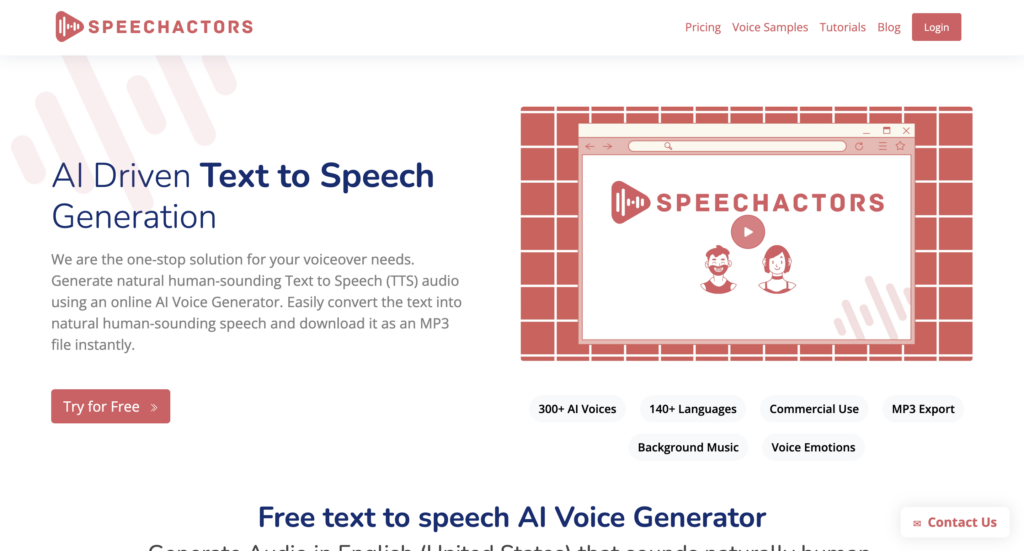
Speechactors applies neural TTS, expressive prosody control, and scalable APIs to deliver production-ready AI voices. The platform is not just a wrapper; it is a sophisticated implementation of the technologies described above. It combines the precision of transformer-based acoustic models with the speed of HiFi-GAN vocoders.
The platform aligns with industry-validated architectures used by leading research labs. By integrating text normalization, emotional control, and high-fidelity rendering, Speechactors provides a tool that meets the needs of modern content creators. Whether for YouTube videos, e-learning modules, or marketing ads, the engine working behind the scenes ensures the output is indistinguishable from human speech.
People Also Ask
What powers an AI voice engine?
An AI voice engine is powered by neural networks trained on linguistic, acoustic, and speech data. These networks learn to replicate human speech patterns.
How does text become speech in AI?
Text becomes speech through phoneme conversion, acoustic modeling, and vocoder synthesis. The text is first broken into sounds, then mapped to audio waves.
Why are neural vocoders important?
Neural vocoders generate high-fidelity audio with natural tone and low latency. They replace older, robotic-sounding methods with smooth, realistic speech.
Can AI voice engines support multiple languages?
Yes, multilingual AI voice engines use shared phonetic models to support many languages efficiently. This allows them to switch between languages without losing voice quality.
Conclusion
An AI voice engine is powered by text processing, acoustic modeling, neural vocoders, and real-time inference working together as a unified system. It is a complex chain of technologies that starts with simple text and ends with rich, expressive audio.
Speechactors leverages this technical anatomy to deliver natural, expressive, and scalable synthetic speech. By understanding the science behind the software, users can better appreciate the quality and capability of the tools at their disposal.