

Text-to-Speech (TTS) technology enables businesses to reach global audiences by delivering content in over 140 languages with native-level clarity. In a digital landscape where users increasingly demand content in their mother tongue, relying solely on English is a missed opportunity. Modern TTS bridges this gap, allowing brands to speak directly to customers in Tokyo, Berlin, and Mumbai without the logistical nightmare of recording studios.
We live in an era of globalization where digital products cross borders instantly, yet language remains a formidable barrier. As audio content consumption skyrockets from podcasts to localized video marketing the ability to scale voice content rapidly is no longer a luxury; it is a necessity for growth.
What Is Text to Speech Technology?
Text-to-Speech (TTS) is an assistive technology that reads digital text aloud with a synthesized voice. While early versions sounded robotic and disjointed, modern AI-driven TTS converts written text into natural, human-like speech that captures intonation and emotion.
Today’s systems rely on neural TTS and deep learning. Instead of just stitching together pre-recorded sounds, these models learn from vast datasets of human speech to predict how a sentence should sound based on context. This is why a question sounds like a question, and a whisper sounds like a whisper. Language coverage is the critical multiplier here; the best engines don’t just speak English they understand the nuance of Mandarin tones, the speed of Spanish, and the rhythm of Hindi.
Why Language Access Is Critical for Global Market Expansion
Language acts as the first and most significant market entry barrier. If a potential customer cannot understand your value proposition, they will not buy. Global studies consistently show that users prefer to consume content in their native language, even if they are fluent in English. Trust is built on familiarity, and nothing is more familiar than one’s own language.
Localized audio significantly improves comprehension, retention, and conversion. When a user hears an explanation in their native dialect, the cognitive load decreases, allowing them to focus on the message rather than translation. Furthermore, providing content in multiple languages is a key step toward inclusivity. It ensures your product meets accessibility compliance standards, serving not just international users but also those with literacy challenges or visual impairments who rely on auditory learning.
How 140 Plus Languages Expand Market Reach
Multilingual TTS allows for instant localization without the need to hire voice actors for every single region. Traditionally, launching a product in five new countries meant hiring five different voice artists, booking studios, and managing weeks of post-production. With TTS, you can generate those five languages in minutes.
This capability is a game-changer for entering emerging markets in Asia, Africa, Europe, and Latin America. These regions often have high mobile adoption rates and a strong preference for voice-first interfaces. For startups and enterprises alike, this offers massive scalability. You can test a marketing campaign in Vietnam or Brazil with minimal upfront investment. If the market responds, you scale; if not, you pivot without having wasted thousands on recording fees. This drastically accelerates go-to-market timelines, turning months of localization work into an afternoon task.
Use Cases of Multilingual TTS Across Industries
The versatility of TTS means it isn’t limited to just one sector. Here is how different industries are leveraging 140+ languages to grow.
E-learning and EdTech
Educational platforms are using multilingual TTS to democratize learning. They can instantly convert text-based lessons, training modules, and certification courses into audio formats for students worldwide. Research shows that learning outcomes improve significantly when students are taught in their native language. By offering a biology course in 40 languages, an EdTech company doesn’t just expand its catalog; it expands its potential user base by millions.
Marketing and Advertising
In marketing, speed and personalization are everything. Brands use TTS to create localized ads, explainer videos, and product demos. instead of running a generic English ad globally, they can run specific audio ads in French for Canada and Spanish for Mexico. Audio personalization leads to higher engagement rates because the content feels bespoke to the listener’s culture and region.
Media and Entertainment
The media industry uses TTS to produce audiobooks, podcasts, and dubbing at scale. Independent authors can now turn their written books into audiobooks in German or Japanese without the high cost of human narration. This supports audience growth through regional language support, allowing creators to monetize content in markets they previously couldn’t access.
Customer Support and IVR
Automated customer support is perhaps the most practical use case. Companies use TTS to power Interactive Voice Response (IVR) systems in multiple languages. This ensures that a caller from Italy gets help in Italian, while a caller from China gets help in Mandarin, all from the same automated system. This connects directly to reduced support costs and higher customer satisfaction scores.
How Speechactors Enables Global Market Access
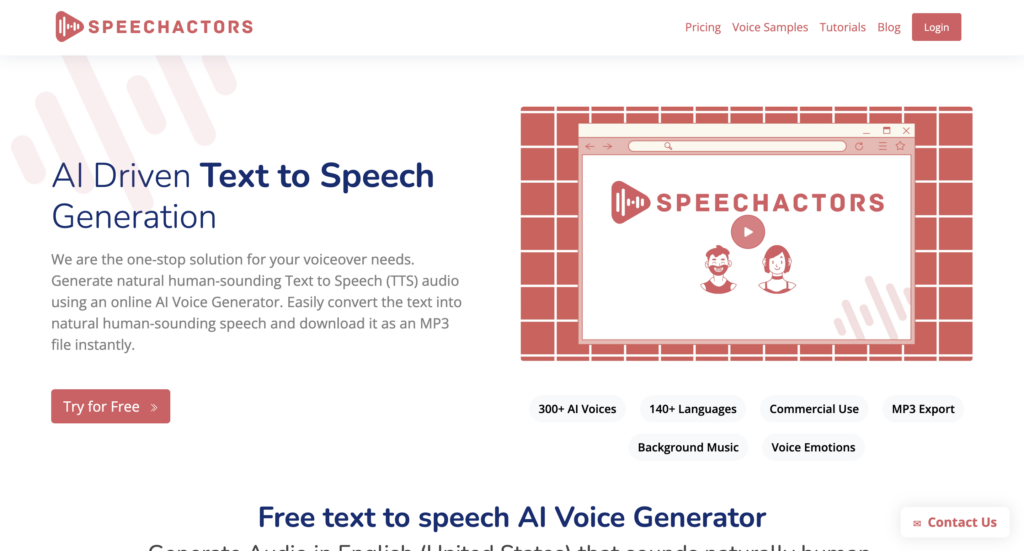
Speechactors stands out as a robust multilingual TTS platform designed for this exact level of global scale. It provides access to over 140 languages and accents, ensuring that your content doesn’t just sound translated it sounds local. With a library of over 300 natural-sounding AI voices, users can find the perfect tone, whether they need a professional newscaster style for a corporate update or a cheerful, casual voice for a social media ad.
The platform is built for ease of integration with global products. Whether you are developing a mobile app or a website, Speechactors allows you to generate audio files that fit seamlessly into your workflow. A key advantage is the consistency of brand voice. You can select a specific voice profile say, a female voice with a calm tone and find equivalent sounding voices across different languages, maintaining a cohesive sonic brand identity from the US to Japan.
SEO and Content Distribution Benefits of Multilingual Audio
Multilingual audio is a powerful, often overlooked SEO tool. Adding audio versions of your articles increases “dwell time” the amount of time a user spends on your page. Search engines interpret this as a signal of high-quality content.
Furthermore, voice search is growing rapidly. Optimizing your content with clear, spoken audio makes it more discoverable via voice-enabled devices like smart speakers. When you produce audio in Spanish, French, or Hindi, you are effectively executing an international SEO strategy. You start ranking for keywords in those languages, opening up traffic sources that are less competitive than English-language search results.
Accessibility and Compliance Advantages
Digital accessibility is governed by standards like the Web Content Accessibility Guidelines (WCAG). TTS is a primary tool for meeting these requirements. It supports visually impaired users globally by making text content audible.
For enterprises and public platforms, this isn’t just about goodwill; it’s about compliance. Legal requirements in many jurisdictions mandate that digital services be accessible to all citizens. By implementing multilingual TTS, businesses ensure they are compliant across borders, avoiding potential legal pitfalls while serving the widest possible demographic.
Challenges in Global TTS Adoption and How They Are Solved
Adopting global TTS does come with challenges, primarily regarding pronunciation accuracy, accents, and cultural context. A word might be pronounced one way in US English and completely differently in Australian English.
Modern AI models solve this by being trained on vast, diverse datasets that include regional dialects. Platforms like Speechactors also offer specific tools to tweak pronunciation (phonemes) and adjust pitch or speed. Continuous language model training ensures that the AI keeps up with evolving slang and terminology, making the output sound less like a machine and more like a local native.
Future of TTS in Global Communication
The future of TTS lies in hyper-local content strategies. We are moving toward a world where AI voices can switch between dialects in real-time based on the user’s location.
We will see a rise in real-time localization, where live broadcasts or customer support calls are translated and spoken instantly in the listener’s language. This has a profound long-term impact on global digital equality. It levels the playing field, ensuring that access to information whether it’s news, education, or health advice is no longer determined by the language you speak.
People Also Ask
What is multilingual text to speech?
Multilingual text to speech is a technology that converts text into spoken audio across multiple languages using AI-based voice models.
Why is TTS important for global businesses?
TTS enables global businesses to communicate consistently across regions while reducing localization costs and time.
How many languages do modern TTS platforms support?
Advanced TTS platforms support over 140 languages and regional voice variations.
Does multilingual TTS improve user engagement?
Studies show content delivered in a user’s native language improves trust, comprehension, and engagement.
Conclusion
Text-to-Speech technology removes the communication barriers that have historically separated businesses from global markets. By leveraging 140+ languages, companies can unlock new audiences, build deeper trust, and scale faster than ever before. Speechactors offers a practical, high-quality solution for this expansion, providing the voices and tools needed to speak the world’s languages. In the race for global attention, the brands that speak the local language will always win.