
Audio content is no longer just a nice-to-have; it is a critical asset for modern digital strategies. Whether it is a podcast, a video narration, or an audiobook, the way your brand sounds directly impacts your bottom line. However, traditional production methods are often too slow and expensive to deliver a strong Return on Investment (ROI).
To see real returns, your audio strategy needs to be scalable, consistent, data-driven, and optimized. This is where AI voice technology changes the game. By integrating AI voiceovers, businesses can produce high-quality audio at a fraction of the cost, ensuring that every piece of content works harder to drive engagement and revenue.
Understanding Audio Content ROI
When we talk about ROI in audio, we are looking at more than just direct sales. Audio content ROI is a comprehensive measure of engagement, conversions, retention, and cost efficiency across every platform you use. If you spend thousands on a single audio ad but it fails to convert listeners, your ROI is negative. Conversely, if you produce hundreds of helpful audio guides at a low cost that retain customers, your ROI skyrockets. The goal is to maximize the value of every second of audio produced while minimizing the resources required to create it.
To accurately track this, you need to look at specific performance indicators. First, look at your Cost per production minute. This metric tells you exactly how much cash you burn to create sixty seconds of finished audio. Second, analyze the Listener completion rate. If people drop off after ten seconds, your message isn’t being heard. Third, track Conversion attribution. You need to know if a listener took action immediately after hearing your content. Finally, consider Brand recall lift and Time to market. The faster you can get relevant audio to your audience, the higher your potential return.
- Cost per production minute: Lowering this directly boosts margins.
- Listener completion rate: Indicates content relevance and quality.
- Conversion attribution: Links audio directly to sales or sign-ups.
- Brand recall lift: Measures long-term impact on memory.
- Time to market: Speed is a competitive advantage in content.
Why Audio Content Performance Depends on Voice Quality?
The voice you choose is the bridge between your brand and your customer. Voice quality directly affects listener trust, comprehension, and the likelihood of them taking action. A robotic, scratchy, or monotone voice signals low quality, causing listeners to tune out almost instantly. On the other hand, a clear, warm, and professional voice creates an immediate connection. It signals authority and reliability. If your audience cannot understand the speaker or finds the tone irritating, they will not stay long enough to hear your call to action.
There is strong science backing this up. Research from Stanford University indicates that voice clarity and tone significantly influence perceived credibility and message retention. When a voice flows naturally with the right emotional inflection, the brain processes the information more easily. This “processing fluency” makes the listener feel that the message is true and valuable. If you want your audio content to perform well, you cannot compromise on the quality of the voiceover. It is the single most important variable in audio engagement.
What Are AI Voiceovers?
AI voiceovers are not the old, robotic computer voices of the past. Today, they utilize advanced neural text-to-speech (TTS) models that have been trained on vast datasets of human speech patterns. These models understand context, pacing, and intonation, allowing them to generate audio that sounds indistinguishably human. The technology analyzes the text to determine how a sentence should be spoken, where to pause, and which words to emphasize. This results in a smooth, natural listening experience that rivals professional human recording.
The core attributes of modern AI voiceovers make them incredibly versatile for business. Natural prosody ensures the rhythm of speech feels organic, not mechanical. Multi-language support allows a single script to be converted into dozens of languages instantly, opening up global markets. Consistent tone at scale means your brand sounds the same in every video, regardless of when it was produced. Finally, Rapid production turnaround means you can go from script to finished audio in minutes rather than days.
- Natural prosody: Mimics the rhythm and flow of real human conversation.
- Multi-language support: Instantly localize content for global audiences.
- Consistent tone: Maintains brand identity across all media assets.
- Rapid production: Eliminates waiting times for recording sessions.
How AI Voiceovers Improve ROI?
Integrating AI voiceovers into your workflow improves ROI in two distinct ways: it drastically reduces the cost of production and it significantly increases the volume of content you can output. Traditional recording requires hiring talent, booking studios, and editing hours of raw files. AI removes these friction points entirely. By lowering the barrier to entry, you can produce more content, test more variations, and reach more people without increasing your budget. This efficiency turns audio from a bottleneck into a growth lever.
The measurable drivers of this ROI are clear. Businesses often see an up to 80 percent reduction in voice production costs when switching to AI. This savings goes straight to the bottom line. Additionally, you benefit from faster content deployment cycles. Being able to publish news or updates immediately gives you an edge. You also achieve localization without hiring multiple artists, saving thousands in talent fees. Perhaps most importantly, you ensure a consistent brand voice across every channel, which builds trust and recognition over time.
- Cost Reduction: Save up to 80% compared to traditional voice recording.
- Speed: Deploy content in minutes, keeping your brand agile.
- Localization: Translate and dub content without extra hiring costs.
- Consistency: A unified voice builds stronger brand equity.
Use Cases That Generate High ROI
Not all audio content is created equal. AI voiceovers generate the highest ROI when applied to formats that are repeatable, scalable, and information-heavy. These are areas where the cost of human voiceovers would be prohibitive due to the sheer volume of content needed. By using AI here, you can populate entire libraries of content that work for you 24/7. The key is to identify areas in your business where audio can add value but has previously been too expensive to implement.
High-impact audio formats include:
- Podcast intros and outros: Keep your branding professional and consistent across episodes.
- **YouTube narration:**Create faceless video channels that drive ad revenue and traffic.
- E-learning modules: Update course material instantly without re-hiring talent.
- Product explainers: clear, articulate guides that help customers understand your offer.
- IVR and customer support: Professional phone menus that guide users efficiently.
- Ad creatives: Generate dozens of ad variations to test which copy converts best.
Role of AI Voiceovers in Content Repurposing
One of the smartest ways to drive ROI is through content repurposing. You have likely already spent time and money creating blogs, whitepapers, and video scripts. AI voiceovers enable you to unlock the value trapped in that text by converting it into audio formats. This effectively doubles your content output without doubling your creative effort. A single written piece can become a podcast episode, a social media clip, and an audio article, reaching different segments of your audience who prefer listening over reading.
Consider these repurposing examples. You can take your top-performing blogs and convert them into podcasts, allowing users to consume your advice during their commute. Video scripts can be reused for audio ads on Spotify or radio, expanding your reach to new platforms. Internal training documents can be transformed into audio lessons for employee onboarding, making learning more accessible. This strategy squeezes every drop of value from your original content investment.
How Brands Use AI Voiceovers at Scale?
For large brands and media publishers, speed and volume are everything. They use AI voiceovers to maintain a relentless publishing schedule that human teams simply could not match. It is about maintaining presence. If a competitor publishes five videos a week and you only publish one, they will capture the market share. AI allows brands to scale up production to meet this demand without sacrificing quality or breaking the bank. It also ensures that the brand voice remains uniform, whether the content is for the US market or expanded into Europe and Asia.
Industry adoption is growing rapidly. Companies publishing on platforms like Spotify, YouTube, and TikTok rely heavily on automated audio workflows. News agencies use it to read articles aloud. E-commerce giants use it for thousands of product descriptions. These organizations understand that to win the attention economy, they must be everywhere at once. AI voiceovers provide the scalable infrastructure needed to meet this massive content demand efficiently.
Cost Comparison Between Human and AI Voiceovers
When you analyze the long-term financial impact, AI voiceovers offer a distinct advantage over human talent for bulk content. Human voice actors are incredibly talented and essential for high-stakes, emotional creative work. However for routine, high-volume tasks, the costs add up quickly. You pay for the artist’s time, the studio time, the engineer, and the rights to use the audio. If you need a script change a week later, you have to pay for the whole process again.
Cost efficiency breakdown with AI is straightforward. There is no studio booking fee; you produce from your laptop. There are no reshoots or re-recordings that cost extra money; you simply edit the text and regenerate the audio. There are no scheduling delays waiting for an actor to be available. Finally, you usually operate on a predictable pricing model, such as a monthly subscription, rather than variable project fees. This predictability allows for better budget planning and higher margins.
How Speechactors Helps Drive Audio ROI
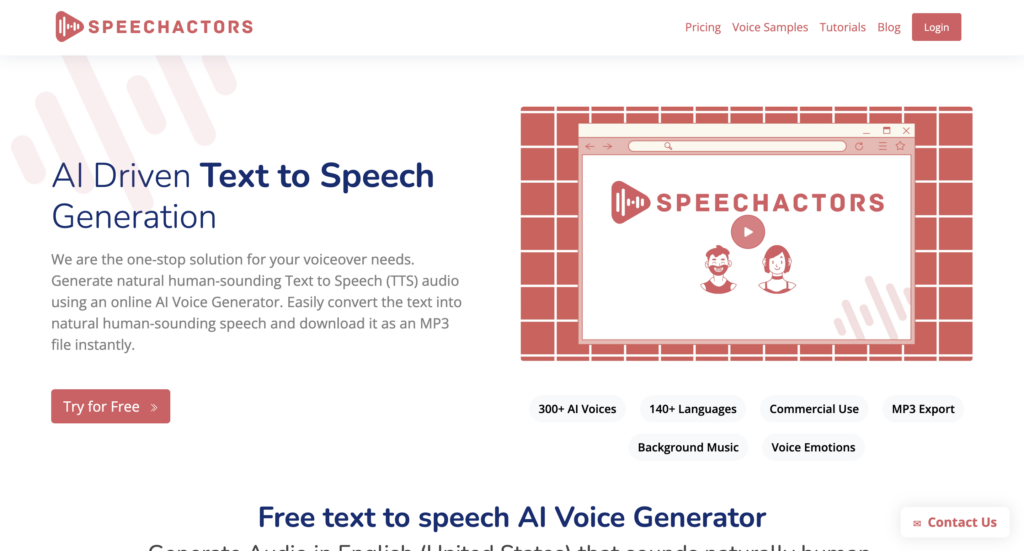
Finding the right tool is essential for executing this strategy. Speechactors is a platform designed specifically to help businesses create professional AI voiceovers that drive results. It bridges the gap between robotic text-to-speech and expensive human recording. By focusing on clarity, emotion, and scalability, Speechactors enables you to produce audio that sounds authentic and engaging. It is built for marketers and creators who need high-quality output without the technical headache.
The platform capabilities are robust. You get access to multiple voice styles and accents, ensuring you can match the right persona to your brand. The fast audio generation engine means you can produce hours of content in minutes. Crucially, it includes commercial usage rights, so you never have to worry about copyright strikes on your ads or videos. With scalable pricing for teams, it fits businesses of all sizes looking to maximize their audio ROI.
Best Practices to Maximize ROI from AI Voiceovers
Buying the tool is only the first step. To truly maximize your return, you must use AI voiceovers strategically. The audio must align perfectly with your content goals and the intent of your audience. If the voice does not match the message, the ROI drops. For example, a serious medical explainer needs a calm, authoritative voice, while a toy commercial needs high energy. Testing and optimization are key to finding the sweet spot that converts listeners into customers.
Follow this optimization checklist:
- Match voice tone to content purpose: Ensure the emotion fits the topic.
- Use short, clear scripts: AI performs best with concise, well-structured text.
- Optimize pacing: Adjust the speed so listeners have time to absorb information.
- Test variations: Generate two or three different voices to see which performs best.
- Track performance: Monitor your metrics to see if the audio is actually driving action.
Compliance, Ethics, and Brand Safety
As with any powerful technology, AI voice usage comes with responsibilities. To protect your brand reputation and ensure long-term ROI, you must adhere to ethical guidelines. Listeners value transparency. If they feel tricked or misled by a synthetic voice, it can damage trust. Furthermore, navigating the legal landscape of voice rights is critical to avoid lawsuits or takedowns. Brand safety means ensuring your audio content is created legally and ethically.
Key governance considerations include providing clear disclosure that the voice is AI-generated where required by law or platform policy. You must show respect for voice licensing terms, ensuring you have the commercial rights to the specific AI model you are using. Finally, avoid misleading impersonation; never use AI to mimic a public figure or celebrity without explicit permission. Ethical usage builds a sustainable strategy that protects your brand for the long haul.
People Also Ask
What is AI voiceover ROI?
AI voiceover ROI is the measurable return gained from reduced production costs, faster delivery, and improved engagement using AI generated voices. It is calculated by comparing the cost savings and revenue lift against the subscription or usage fees of the AI tool.
Can AI voiceovers replace human voice actors?
AI voiceovers complement human voice actors by handling scalable and repetitive content while humans focus on high emotion roles. They are tools for efficiency, allowing human talent to be reserved for premium, creative campaigns where nuance is irreplaceable.
Are AI voiceovers suitable for commercial use?
AI voiceovers are suitable for commercial use when platforms provide proper licensing and usage rights. Always ensure your AI provider, like Speechactors, grants you full commercial ownership of the generated audio files to avoid legal issues.
Conclusion
The shift toward audio-first content is undeniable, and the brands that adapt quickly will see the biggest rewards. AI voiceovers drive ROI by making audio content faster, scalable, cost-efficient, and measurable across digital channels. By moving away from slow, manual production cycles and embracing AI, you can produce consistent, high-quality audio that engages your audience and converts them into loyal customers. Start small, measure your results, and scale what works.